Pinksummer goes to Monte San Savino
Comunicato stampa
Pinksummer
è lieta di presentare / is pleased to announce:
Of Water and Other Reflections for Change
Michael Beutler
Mariana Castillo Deball
Luca De Leva
Mark Dion
Peter Fend
Tobias Putrih
Tomás Saraceno
Bojan Šarčević
Georgina Starr
Luca Trevisani
Opening 30.06.26 | 6.30 pm
Monte San Savino, AR, Italy
English text below
Comunicato stampa
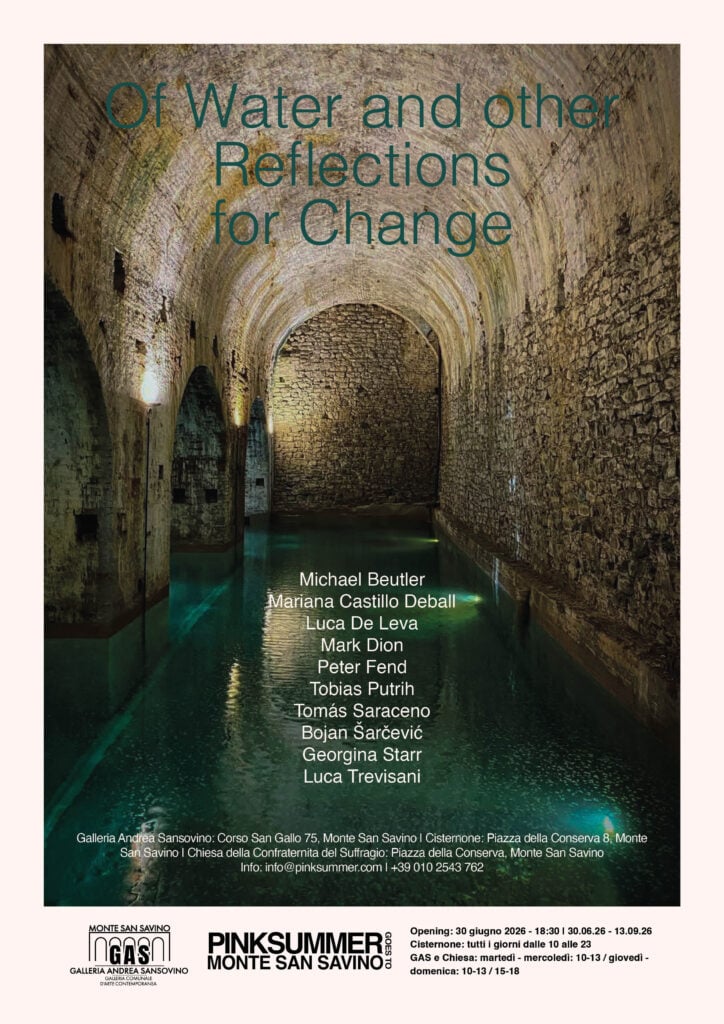
Of Water and other Reflections for Change, “Dell’acqua e altre riflessioni per il cambiamento”, è una mostra che muove dall’acqua immota e limpidissima della grande cisterna rinascimentale a due navate di Monte San Savino. Il Cisternone un tempo attingeva le sue acque da sorgenti sotterranee, e serviva la comunità attraverso le cannelle poste sulle antiche mura del borgo.
In L’eau et les rêves Gaston Bachelard, cresciuto vicino a un fiume, afferma che l’acqua dolce è la vera acqua mitica, a differenza di quella marina, disumana e perigliosa, più vicina all’infinito. L’acqua è l’elemento che più di ogni altro sostanzia il sogno, è la materia che dissolvendo la consistenza induce alla rêverie rispetto e all’esistenza e all’esistente.
Circa la dissolvenza fluida dei costrutti, ci sembra appropriato inserire nella cisterna un’opera di Luca Trevisani che rimanda alle origini fantasmatiche e rituali della nostra civiltà: si tratta di un lavoro sonoro in cui l’artista ha tradotto in alfabeto morse le coordinate geografiche dell’Addaura, una grotta vicino a Palermo che è attualmente chiusa al pubblico, ma custodisce preziose incisioni rupestri. Attraverso un programma disponibile gratuitamente in rete, egli ha infine trasformato in suono il codice morse delle coordinate geografiche della grotta, restituendo un mantra senza tempo e fuori da ogni luogo: astrale.
I riflessi o le ulteriori riflessioni proseguono in altre sembianze nella chiesa barocca della Confraternita del Suffragio, costruita dall’ampliamento della precedente chiesa cinquecentesca della Santissima Trinità. Questa chiesa è un luogo inedito, giacché sebbene l’esterno sia stato recentemente restaurato, l’interno è rimasto sinora chiuso al pubblico, e il ciclo di affreschi di Luigi Ademollo sulla deposizione dalla croce è stato staccato per motivi di conservazione.
Abbiamo immaginato che in questo luogo incantassero con i loro riverberi iridescenti due Foam di dimensioni diverse di Tomás Saraceno, una serie di sculture dalla consistenza “liquida”. Le Foam rimandano di fatto alla schiuma, alla geometria interna di un frattale rinvenibile ovunque in natura. Nel terzo e ultimo volume della Trilogia delle Sfere, dedicato alla società contemporanea, Peter Sloterdijk fa che le sfere si dissolvano nella schiuma. La schiuma simboleggia la fine della narrazione monocentrica e in qualche modo il tentativo di riorientare la soggettività dopo il collasso dei pensieri dirigistici. D’altra parte la vita è sempre una questione di ritrovare una forma.
Qui saranno presentate anche le opere di altri tre artisti, che rimandano al riordino dell’identità e all’ecologia, perché come affermava Félix Guattari, non può esistere alcuna ecologia senza muovere dalla trasformazione psicologica dell’individuo.
All’interno della chiesa si potrà vedere dunque lo splendido cabinet di Mark Dion Davy Jones’ Locker, un mobile le cui due ante presentano la figura di un gabbiano tratto da un disegno di Dion, finemente intarsiato con differenti essenze di legno. L’opera, realizzata per la personale dell’artista americano By the Sea del 2021 da Pinksummer, e tenutasi in un palazzo seicentesco della Strada Nuova di Genova, presenta all’interno una serie di contenitori in vetro, in cui l’artista ha raccolto secondo la tipologia (palline, tappi, fascette elettriche) la plastica che il mare restituisce, il marine debris raccolto sulle spiagge di Genova. Il cassetto del cabinet contiene una cartina della Liguria e del suo mare bellissimo e abusato, come ogni mare in ogni dove sul pianeta Terra.
In chiesa ci sarà poi il light box di Peter Fend, artista americano che fin dagli anni Settanta ha trasformato la sua arte in attivismo ambientale. L’insegna rimanda ai colori dei distributori IP, ma la scritta “Global Desert” rivela la reale conseguenza dell’uso dei combustibili fossili: la trasformazione del pianeta in un deserto globale.
L’ultima opera è una lampada di Michael Beutler, costruita con materiali poverissimi di cantiere e con l’aiuto delle macchine che egli stesso realizza e spesso espone accanto alle opere, sorte di grandi attrezzi privi di elettricità che avvicinano il processo artistico al percorso manifatturiero. Michael Beutler ha un approccio anticonsumista e vede nell’empowerment che promuove l’autosufficienza una matrice di cambiamento per il sostrato ontologico sociale.
La mostra prosegue nella GAS (Galleria Andrea Sansovino), diretta da Giuseppe Simone Modeo. Qui saranno presentate di Michael Bleutler le recenti Treasure Box in cartapesta, piccole sculture ispirate alle scatole per il sale delle antiche case di campagna, che l’artista ha realizzato con gli scarti della grande installazione partecipativa e straniante Onion, presentata da Pinksummer lo scorso febbraio.
Di recentissima produzione e presentata per la prima volta nei locali della GAS in Palazzo Sansovino Muffa semiotica, un’installazione di Luca De Leva costituita da piccole poesie, realizzate assemblando stringhe di testo prese dai foglietti illustrativi dei prodotti di cura per il corpo: una sorta di esercizio di annientamento del sé correlato al progetto Thyself Agency, in cui l’artista propone una serie esercizi per uscire dall’abitudine, tra cui il temporale scambio di vita, che De Leva intende come un viaggio radicale all’interno di se stessi che si attiva lasciando la propria routine per mimare quella dell’altra persona. De Leva definisce Thyself Agency una “agenzia di viaggio”.
Saranno presentati in galleria i tarots femministi e alchemici di Georgina Starr, usati nel suo ultimo film Quarantaine, in cui due giovani ragazze, attraversando un portale (il tronco cavo di un albero), abbandonano la realtà di un parco londinese e si abbandonano all’ignoto: un mondo fatto di regole altre, nuovi sistemi educativi, misteriose lingue da imparare. Si tratta di un’installazione costituita da trentatré acquerelli, da cui l’artista ha tratto anche un’edizione di carte.
Luca Trevisani nella galleria sarà presente con una scultura della serie Ai piedi del Pane, opere di pane plasmato con suole di scarpe, stabilizzato con le resine e posto su un prezioso attrezzo ligneo da calzolaio rifasciato in foglia d’oro zecchino. L’opera rimanda al cammino dell’uomo e all’invenzione del pane come svolta decisiva per il progresso della civiltà. Trevisani afferma che la dieta è una sorta di scultura sociale che informa comportamenti, abitudini, patologie.
Nei suoi disegni, presentati anch’essi all’interno della galleria, Mark Dion ricalca le tabelle di classificazione scientifica a scopo didattico deviando le notazioni, in modo assolutamente arbitrario e talvolta esilarante, sulla cultura e sui problemi ecologici più pressanti della contemporaneità.
Abbiamo voluto inserire in mostra anche un collage di Tobias Putrih, realizzato come una sorta di meditazione quotidiana che muove dal gesto di mangiare un uovo a colazione, frantumarne il guscio e realizzare con i piccoli frammenti un’opera spaziale, perfetta e raffinatissima.
Infine, di Saraceno presenteremo in galleria due Spidermap, ragnatele su carta. Le Spidermap vengono realizzate ponendo ragni di speci diverse a collaborare, in sequenza, in una cornice aperta di fibra di carbonio. In questo caso, finito il lavoro e rimossi i ragni, Saraceno stende la ragnatela sulla carta, mantenendone la prospettiva originaria e cospargendola di polvere di grafite che la rendono visibile sul foglio bianco. Ogni tela viene infine incorniciata e protetta dal Museum Glass. Il titolo indica sempre quali specie di ragno hanno collaborato (ragni sociali, semi-sociali o solitari), per quante settimane hanno lavorato e, se la cornice in fibra di carbonio è stata ruotata, di quanti gradi. Saraceno ha iniziato a lavorare in collaborazione con i ragni intorno al 2009, muovendo dalla teoria delle super stringhe e dalla sensibilità olistica che il microcosmo rispecchi il macrocosmo, e che la tela di ragno assomigli alla materia oscura: la materia che compone il 70% del nostro universo, e di cui è costituita la grande rete cosmica che sostiene galassie e mondi.
***
Press release
Of Water and Other Reflections for Change is an exhibition that begins with the still, crystal-clear water of the great two-nave Renaissance cistern of Monte San Savino. Once fed by underground springs, the Cisternone supplied water to the local community through spouts set into the ancient walls of the town.
In L’eau et les rêves (Water and Dreams), Gaston Bachelard, who grew up near a river, argues that freshwater is the truly mythical water, unlike seawater, which is inhuman and perilous, closer to the infinite. Water is the element that most profoundly substantiates dreaming; it is the substance that, by dissolving solidity, induces a rêverie on existence and all that exists.
Reflecting on the fluid dissolution of constructs, it seems fitting to place within the cistern a work by Luca Trevisani that alludes to the phantasmatic and ritual origins of our civilization. This is a sound piece in which the artist translated into Morse code the geographical coordinates of the Addaura, a cave near Palermo that is currently closed to the public but preserves invaluable prehistoric petroglyphs. Using a software freely available online, he then converted the Morse code of the cave’s coordinates into sound, creating a timeless mantra detached from any specific place: astral.
These reflections, or further reflections, continue in different forms within the Baroque Church of the Confraternity of Suffrage, built through the expansion of the earlier sixteenth-century Church of the Holy Trinity. This is a largely undiscovered site: although the exterior has recently been restored, the interior has remained closed to the public until now, and Luigi Ademollo’s fresco cycle depicting the Deposition from the Cross has been removed for conservation purposes.
We imagined this space enchanted by the iridescent reflections of two Foam sculptures of varying dimensions by Tomás Saraceno, a series of works with a “liquid” consistency. In fact, the Foams evoke foam itself, the internal geometry of a fractal that can be found anywhere throughout nature. In the third and final volume of the Spheres Trilogy, devoted to contemporary society, Peter Sloterdijk allows spheres to dissolve into foam. Foam symbolizes the end of monocentric narratives and, in some sense, an attempt to reorient subjectivity after the collapse of interventionist ideas. After all, life is always a matter of finding a form again.
Here, works by three more artists will also be presented, all addressing the reordering of identity and ecology, because, as Félix Guattari argued, no ecology can exist without first engaging in the psychological transformation of the individual.
Inside the church visitors will therefore encounter Mark Dion’s remarkable cabinet Davy Jones’ Locker, a piece of furniture whose two doors feature a seagull based on one of Dion’s drawings, intricately inlaid with different wood species. Created for the American artist’s 2021 solo exhibition By the Sea, presented by Pinksummer in a seventeenth-century palazzo on Genoa’s Strada Nuova, the cabinet contains a series of glass vessels in which the artist has sorted marine debris collected on Genoa’s beaches according to type (plastic balls, bottle caps, cable ties, and other objects returned by the sea). The drawer of the cabinet contains a map of Liguria and its beautiful yet exploited sea, much like every sea everywhere on Earth.
Also on view will be a light box by Peter Fend, the American artist who, since the 1970s, has transformed his artistic practice into environmental activism. The sign recalls the colors of IP gas stations, but the words “Global Desert” reveal the true consequence of fossil fuel consumption: the transformation of the planet into a global desert.
The last work is a lamp by Michael Beutler, constructed from humble building-site materials with the aid of machines that he designs and often exhibits alongside his artworks: sort of large, electricity-free devices bringing artistic production closer to traditional craftsmanship. Beutler’s anti-consumerist approach views empowerment promoting self-sufficiency as a catalyst for change within the ontological foundations of society.
The exhibition continues at GAS (Galleria Andrea Sansovino), directed by Giuseppe Simone Modeo. Here, recent papier-mâché Treasure Boxes by Michael Beutler will be presented: small sculptures inspired by the salt boxes once found in rural homes, created from the remnants of the large participatory and disorienting installation Onion, presented by Pinksummer last February.
Making its debut in the rooms of GAS at Palazzo Sansovino is Muffa semiotica (Semiotic Mold), a recently produced installation by Luca De Leva composed of short poems, assembled from fragments of text taken from the package inserts of personal care products: a form of self-erasure exercise connected to the project Thyself Agency, through which the artist proposes a series of exercises designed to disrupt habitual behavior. Among them is the temporary exchange of lives, which De Leva describes as a radical inward journey activated by abandoning one’s own routine and mimicking that of another person. He defines Thyself Agency as a “travel agency.”
The gallery will also present Georgina Starr’s feminist and alchemical tarots, used in her latest film Quarantaine, in which two young girls pass through a portal (a hollow tree trunk), leave behind the reality of a London park and surrender themselves to the unknown: a world governed by different rules, new educational systems, and mysterious languages to be learned. The installation consists of thirty-three watercolors from which the artist also produced an edition of cards.
Luca Trevisani will be represented in the gallery by a sculpture from his series Ai piedi del Pane (At the foot of bread), works made of bread molded with shoe soles, stabilized with resins and placed upon a precious wooden cobbler’s tool wrapped in pure gold leaf. The work evokes the human journey and the invention of bread as a decisive turning point in the progress of civilization. Trevisani maintains that diet functions as a form of social sculpture, shaping behaviors, habits, and pathologies.
In the drawings also presented in the gallery, Mark Dion appropriates the format of scientific classification charts used for educational purposes, only to divert their notations, arbitrarily and often humorously, toward culture and some of today’s most pressing ecological concerns.
We also wished to include in the exhibition a collage by Tobias Putrih, created as a kind of daily meditation inspired by the simple act of eating an egg for breakfast, breaking its shell, and transforming the fragments into a perfect, exquisite spatial composition.
Finally, the gallery will present two Spidermaps by Tomás Saraceno, spider webs transferred onto paper. These works are created by inviting spiders of different species to collaborate sequentially within an open carbon-fiber frame.In this instance, once the spiders have completed their work and been removed, Saraceno carefully transfers the web onto paper, preserving its original perspective and dusting it with graphite powder to make it visible against the white surface. Each web is then framed and protected with Museum Glass. The title always specifies which spider species collaborated (whether social, semi-social, or solitary), how many weeks they worked, and, if the carbon-fiber frame was rotated during the process, by how many degrees. Saraceno began collaborating with spiders around 2009, inspired by the superstring theory and the holistic sensibility that the microcosm reflects the macrocosm, and that the spider web resembles dark matter: the substance that constitutes approximately 70% of our universe and forms the vast cosmic network supporting galaxies and worlds.
