

Clarissa Tossin | Tenki Hiramatsu
Due mostre.
Comunicato stampa
Clarissa Tossin
Piante Vagabonde (Wandering Plants)
kaufmann repetto is pleased to present Piante Vagabonde (Wandering Plants), the first solo exhibition with the gallery by Brazilian artist Clarissa Tossin, bringing together a new body of recent works. Through painting, sculpture, installation, and video, Tossin develops a practice that intertwines ecology, colonial history, and the exploitation of natural resources, examining the relationship between the body, the landscape, and socioeconomic infrastructures. Her work is grounded in the idea that nature is not a realm separate from human experience, but rather a network of relationships of which we are an integral part—one shaped by material and political histories that continue to inform the present. In recent years, her work has been presented at major international institutions, including the recent survey exhibition Point of No Return at the Museu de Arte de São Paulo (MASP), which closed in February 2026, further consolidating a practice that addresses the legacies of extractivism and contemporary ecological transformations.
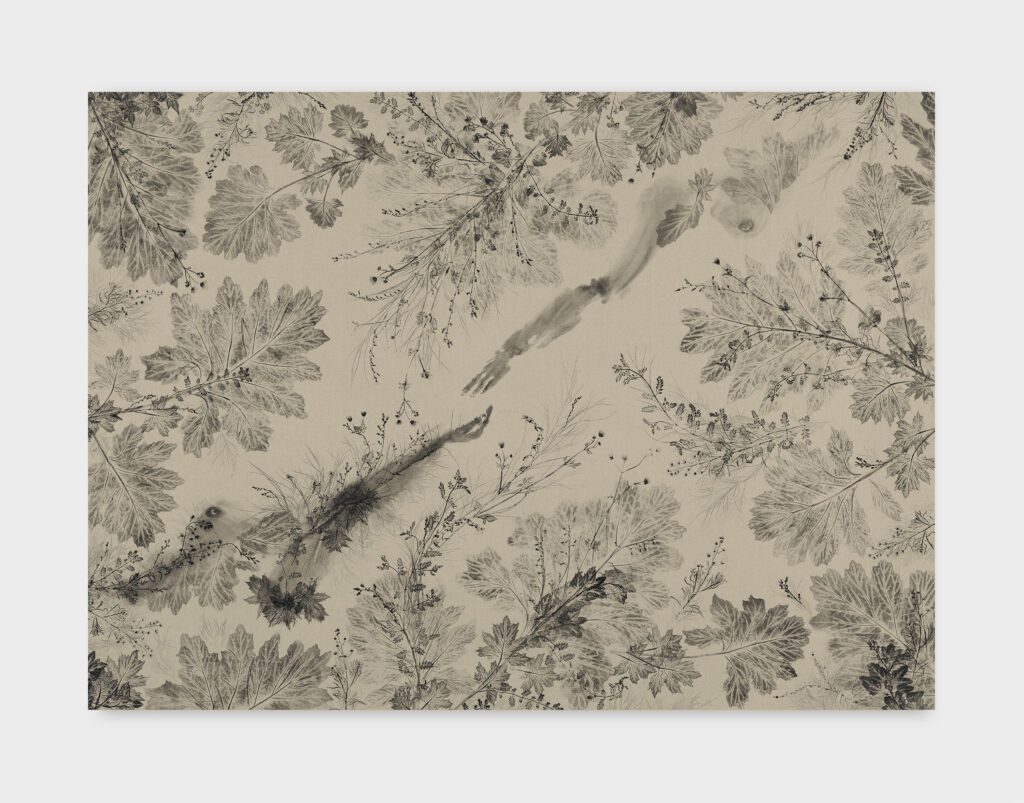
At the heart of the exhibition is the series Piante Vagabonde, first conceived during the artist's residency at the American Academy in Rome in 2025. The works emerge from the direct encounter between the artist's body and spontaneous plant species—so-called "wandering plants"—collected from urban margins, roadsides, and disturbed landscapes, and imprinted onto the surface of the canvas. The plants that lend the series its title are resilient organisms capable of growing in degraded soils and thriving under extreme conditions, actively contributing to the regeneration of damaged environments. Rather than functioning simply as botanical subjects, they become witnesses to forms of ecological adaptation that resonate with histories of migration, environmental transformation, and resistance. These works evoke the contact between body and vegetation as a space of mutual belonging, connecting the vulnerability of ecosystems with that of human bodies, while opening a reflection on the possibility of imagining new forms of coexistence in a time marked by the devastating consequences of climate change.
These same concerns run through a group of works made from recycled Amazon shipping boxes and envelopes. For years, Tossin has employed these materials—symbols of global logistics and the disposable economy—transforming them through a slow process of dismantling, weaving, and reassembling. Upon these surfaces emerge historical maps, satellite imagery, and representations of Brazil's great rivers, bringing cartography into dialogue with contemporary technologies of territorial observation and control. The waterways of the Amazon basin, once routes of colonial expansion and the transport of resources to Europe, overlap with the infrastructures of global commerce and the new geographies of space exploration, suggesting how extractive logics continue to reshape territories that appear geographically distant. The manual gesture of weaving introduces an alternative temporality, countering the speed of global circulation with a practice rooted in care, repair, and the transformation of matter.
In Rising Temperature Casualty (Prunus persica var. nucipersica, home garden, Los Angeles) (2021), Tossin shifts the focus to the intimate scale of her own domestic garden. Cast in translucent silicone, the sculpture incorporates fragments of the original bark of a peach tree that died as a result of prolonged drought and rising temperatures in Los Angeles. The cast preserves the tree's physical memory, transforming it into a fragile, almost epidermal presence in which organic and synthetic materials coexist. The work records the effects of the climate crisis not as an abstract phenomenon, but through the tangible loss of a single living organism.
Finally, the two works from the series Becoming Mineral (2021) are casts of the artist's face made from leftover clay collected in her studio. Created through the accidental combination of different clay bodies, the works acquire a mineral quality that suggests the body in a state of slow transformation. With closed eyes and features suspended between presence and dissolution, the faces evoke both the tradition of the funerary mask and the gradual process of geological sedimentation, proposing a continuity between the human body and the materiality of the earth. Produced during the Covid-19 pandemic, these works reflect on the fragility of the human condition and the urgent need to rethink our relationship with the natural world.
Clarissa Tossin was recently awarded the Bulgari Whitney Biennial American Academy in Rome Fellowship (2025). She has an upcoming travelling group exhibition opening at the Bundeskunsthalle, Bonn (2026), as well as a solo exhibition at the University of Kentucky Art Museum, Lexington, Kentucky (2026). Solo exhibitions include the West Hollywood Public Art Project, West Hollywood (2026); Museu de Arte de São Paulo – MASP, São Paulo (2025); Frye Art Museum, Seattle (2024); Museum of Contemporary Art, Denver (2022); Harvard University, Cambridge (2019); Hammer Museum, Los Angeles (2014); and Blaffer Art Museum, Houston (2013). Her work was included in the Whitney Biennial, New York (2024); Prospect.6 Triennial, New Orleans (2024); 14th Shanghai Biennale (2023); 5th Chicago Architecture Biennial (2023); and the 12th Gwangju Biennial, Gwangju (2018). Her work has recently entered the collections of the Art Gallery of Ontario (AGO), Toronto, and the Mohn Art Collective (MAC3), the jointly owned collection of the Hammer Museum, LACMA, and MOCA, Los Angeles. Her work is also included in the collection of Vancouver Art Gallery, Vancouver; Art Gallery of Ontario, Toronto; Frye Art Museum, Seattle; Hammer Museum, Los Angeles; Harvard Art Museums, Cambridge; Los Angeles County Musuem of Art, Los Angeles; Whitney Museum of American Art, New York; Seattle Art Museum, Seattle; and The Museum of Fine Arts, Houston.
kaufmann repetto è lieta di presentare la prima mostra personale dell’artista brasiliana Clarissa Tossin, Piante Vagabonde, che riunisce un nuovo gruppo di opere. Attraverso pittura, scultura e video, Tossin sviluppa una ricerca che intreccia ecologia, storia coloniale e processi di estrazione, interrogandosi sulla relazione tra corpo, paesaggio e infrastrutture economiche. La sua pratica si fonda sull'idea che la natura non costituisca uno spazio distinto dall'esperienza umana, ma un sistema di relazioni di cui siamo parte, attraversato da memorie materiali e politiche che continuano a plasmare il presente. Negli ultimi anni il suo lavoro è stato presentato in importanti istituzioni internazionali, tra cui la recente personale al Museo de Arte de São Paulo – MASP, Point of No Return, consolidando una ricerca che affronta le eredità dell'estrattivismo e le trasformazioni ecologiche contemporanee.
Fulcro della mostra è la serie Piante Vagabonde, concepita per la prima volta in occasione della residenza dell’artista presso l’American Academy di Roma nel 2025. I lavori nascono dall'incontro diretto tra il corpo dell'artista e specie vegetali spontanee, dette vagabonde, raccolte dai margini urbani, lungo le strade o nei terreni compromessi e impresse sulla superficie della tela. Le piante che danno il titolo alla serie sono organismi capaci di crescere in suoli degradati e di prosperare in condizioni estreme, contribuendo ai processi di rigenerazione del paesaggio. Più che semplici soggetti botanici, diventano testimoni di una capacità di adattamento ecologico che attraversa la storia delle migrazioni, delle trasformazioni ambientali e delle forme di resistenza. Le opere restituiscono il contatto tra corpo e vegetazione come spazio di reciproca appartenenza, mettendo in relazione la vulnerabilità degli ecosistemi con quella dei corpi e aprendo una riflessione sulle possibilità di immaginare nuove forme di convivenza in un tempo segnato dalle conseguenze disastrose del cambiamento climatico.
Queste stesse tensioni attraversano il nucleo di opere realizzate a partire da scatole e buste di Amazon riciclate. Da anni Tossin utilizza questi materiali, simboli della logistica globale e dell'economia dell'usa e getta, trasformandoli attraverso un processo lento di smontaggio, intreccio e ricomposizione. Su queste superfici prendono forma mappe storiche, immagini satellitari e rappresentazioni dei grandi fiumi brasiliani, mettendo in dialogo la cartografia coloniale con le tecnologie contemporanee di osservazione e controllo del territorio. I corsi d'acqua dell'Amazzonia, un tempo vie di penetrazione coloniale e di trasporto delle risorse verso l'Europa, si sovrappongono alle infrastrutture del commercio globale e alle nuove geografie dell'esplorazione spaziale, suggerendo come le logiche estrattive continuino a ridefinire territori apparentemente lontani. Il gesto manuale della tessitura introduce un tempo diverso, opponendo alla velocità della circolazione delle merci una pratica fondata sulla cura, sulla riparazione e sulla trasformazione della materia.
In Rising Temperature Casualty (Prunus persica var. nucipersica, home garden, Los Angeles) (2021), Tossin sposta la riflessione nella dimensione più intima del suo giardino domestico. Realizzata in silicone traslucido, la scultura incorpora i frammenti della corteccia originale di un pesco morto a causa della prolungata siccità e dell’aumento delle temperature a Los Angeles. Il calco dell’albero ne conserva la memoria fisica, trasformandolo in una presenza fragile, quasi epidermica, nella quale materiali organici e sintetici convivono. L’opera registra gli effetti della crisi climatica non come fenomeno astratto, ma attraverso la perdita concreta di un singolo organismo.
Infine, le due opere della serie Becoming Mineral (2021) sono calchi del volto dell'artista realizzati con argille residue provenienti dal suo studio, nate dall’accostamento casuale di impasti differenti, assumendo una qualità minerale, che sembra collocare il corpo in uno stato di lenta trasformazione. Con gli occhi chiusi e i lineamenti sospesi tra presenza e dissoluzione, i volti richiamano la tradizione della maschera funeraria quanto un processo di sedimentazione geologica, suggerendo una continuità tra corpo umano e materia terrestre. Realizzate durante il periodo della pandemia Covid-19, le opere riflettono sulla fragilità della condizione umana e sulla necessità di ripensare il nostro rapporto con il mondo naturale.
Clarissa Tossin ha recentemente ricevuto la Bulgari Whitney Biennial American Academy in Rome Fellowship (2025). Tra i suoi prossimi progetti figurano una mostra collettiva itinerante, che inaugurerà alla Bundeskunsthalle di Bonn (2026), e una mostra personale presso lo University of Kentucky Art Museum, Lexington, Kentucky (2026). Tra le sue mostre personali si ricordano West Hollywood Public Art Project, West Hollywood (2026); Museu de Arte de São Paulo – MASP, San Paolo (2025); Frye Art Museum, Seattle (2024); Museum of Contemporary Art, Denver (2022); Harvard University, Cambridge (2019); Hammer Museum, Los Angeles (2014); e Blaffer Art Museum, Houston (2013). Il suo lavoro è stato incluso nella Whitney Biennial, New York (2024); Prospect.6 Triennial, New Orleans (2024); 14th Shanghai Biennale (2023); 5th Chicago Architecture Biennial (2023); e 12th Gwangju Biennial, Gwangju (2018). Le sue opere sono recentemente entrate a far parte delle collezioni dell’Art Gallery of Ontario (AGO), Toronto, e del Mohn Art Collective (MAC3), collezione congiunta dell’Hammer Museum, LACMA e MOCA di Los Angeles. Il suo lavoro è inoltre presente nelle collezioni della Vancouver Art Gallery, Vancouver; Art Gallery of Ontario, Toronto; Frye Art Museum, Seattle; Hammer Museum, Los Angeles; Harvard Art Museums, Cambridge; Los Angeles County Museum of Art, Los Angeles; Whitney Museum of American Art, New York; Seattle Art Museum, Seattle; e The Museum of Fine Arts, Houston.
Tenki Hiramatsu
Smell of the Lawn
The title of this exhibition – Smell of the Lawn – already suggests something that arrives before an image: a scent, a memory, the invisible trace of a place. In Hiramatsu’s paintings, too, recognition comes slowly. Figures, animals, and fragments of landscapes seem to settle onto the surface after the fact, as though they had been waiting inside the paint. A figure observes the hint of a poppy in Red Flower; a bird almost sinks into the dim ground of Life’s Stumbles; in At That Moment, a witch-like figure hovers at the edge of a swampy landscape. These images remain suspended just before they become fully legible, in the moment when a story seems possible but has not yet begun.
Hiramatsu’s paintings develop through a patient, layered process. He begins without a fixed image, turning first to the surface and how oil moves across it. Patches of color are added, covered, corrected, and reopened, until a motif begins to emerge from the accumulated sediment of the painting. In this sense, the image is not imposed on the surface but found through it: a figure or animal appears as the result of a negotiation between intention, accident, and what the paint itself allows.
There is no firm boundary between Hiramatsu’s subjects and their surroundings. His figures often seem to be made of the same atmosphere that contains them, as if they were projections of the space around them, or as if the space itself had briefly taken on a face. In the work that gives the title to the show, Smell of the Lawn, a small figure folds into a muted field of brown and green, as if gathering breath before a story can begin. Something mossy, pungent, and damp seems buried underneath the surface, rising less as an image than as a sensation. The paintings do not unfold into narrative so much as hold the conditions for one: a pause, a posture, a glance, an atmosphere. Their melancholy remains quiet and almost understated, tempered by moments of humor and awkwardness that keep the images from becoming theatrical.
Even so, Hiramatsu’s work remains close to abstraction. The subject is both a presence and the residue of a search, never fully separable from the painting that produced it. His works ask to be looked at not only as images, but as surfaces that have answered back, resisting, redirecting, and slowly giving form to what was not there at the beginning. Their strength lies in this condition: every figure is at once a subject and the visible trace of the painting’s becoming.
kaufmann repetto presents Smell of the Lawn, a solo exhibition by Tenki Hiramatsu, at the Milan gallery space.
Tenki Hiramatsu (Wakayama Prefecture, Japan, 1986) lives and works in Berlin. He studied at Nihon University College of Art in Tokyo and later at the Staatliche Akademie der Bildenden Künste Karlsruhe. Recent solo exhibitions include Sweat and Tears, Kosaku Kanechika, Tokyo (2026); Hira Hira, Super Dakota, Brussels (2025); Here and Elsewhere, Barbara Seiler Galerie, Zurich (2024); Slow Living, Half Gallery, New York (2024); Breather, Sebastian Gladstone, Los Angeles (2024); and Unendliche Zigarettenpause, Städtische Galerie Karlsruhe, Karlsruhe (2023). His work has been included in group exhibitions at Fondation Fernet Branca, Saint-Louis; Kunsthalle Basel; Claas Reiss, London, among others.
Il titolo della mostra – Smell of the Lawn (L'odore del prato)– suggerisce già qualcosa che arriva prima di un’immagine: un odore, un ricordo, la traccia invisibile di un luogo. Nei dipinti di Hiramatsu la realizzazione avviene lentamente. Figure, animali e frammenti di paesaggio sembrano depositarsi sulla superficie a posteriori, come se fossero rimasti in attesa all’interno della pittura. Una figura osserva l’accenno di un papavero in Red Flower; un uccello quasi sprofonda nel fondo annebbiato di Life’s Stumbles; in At That Moment, una figura simile a una strega si staglia ai margini di un paesaggio paludoso. Queste immagini rimangono sospese appena prima di diventare pienamente leggibili, nel momento in cui una storia diventa possibile, ma non è ancora iniziata.
I dipinti di Hiramatsu si sviluppano attraverso un processo paziente e stratificato. L’artista inizia senza un’immagine prestabilita, rivolgendosi innanzitutto alla superficie e al modo in cui l’olio vi si muove. Campiture di colore vengono aggiunte, coperte, corrette e riaperte, finché un motivo non comincia a emergere dal sedimento accumulato della pittura. In questo senso, l’immagine non viene imposta alla superficie, ma trovata attraverso di essa: una figura o un animale appare come il risultato di una negoziazione tra l'intenzionale, l'occidentale e ciò che la pittura stessa consente.
Non esiste un confine netto tra i soggetti di Hiramatsu e l'ambiente che li circonda. Le sue figure sembrano spesso composte della stessa atmosfera che le contiene, come se fossero proiezioni dello spazio circostante, o come se fosse lo spazio stesso ad aver assunto per un istante un volto. Nell’opera che dà il titolo alla mostra, Smell of the Lawn, una piccola figura si ripiega in un campo sommesso di marroni e verdi, come se stesse raccogliendo il respiro prima che possa raccontare una sua storia. Qualcosa di muschioso, pungente e umido sembra essere sepolto sotto la superficie, emergendo non tanto come immagine quanto come sensazione. I dipinti non si sviluppano in senso narrativo, quanto piuttosto mantengono le condizioni per una narrazione: una pausa, una postura, uno sguardo, un’atmosfera. La loro malinconia rimane quieta e quasi sottintesa, temperata da momenti di umorismo e goffaggine che impediscono alle immagini di diventare teatrali.
Eppure, il lavoro di Hiramatsu rimane profondamente vicino all’astrazione. Il soggetto è al tempo stesso una presenza e il residuo di una ricerca, mai del tutto separabile dal dipinto che lo ha prodotto. Le sue opere invitano a essere osservate non soltanto come immagini, ma come superfici che hanno risposto, resistendo, deviando e dando lentamente forma a ciò che non era presente all’inizio. La loro forza risiede proprio in questo: ogni figura è al contempo un soggetto e la traccia visibile della pittura in divenire.
kaufmann repetto presenta Smell of the Lawn, una mostra personale di Tenki Hiramatsu, presso la sede milanese della galleria.
Tenki Hiramatsu (Prefettura di Wakayama, Giappone, 1986) vive e lavora a Berlino. Ha studiato presso il Nihon University College of Art di Tokyo e successivamente presso la Staatliche Akademie der Bildenden Künste Karlsruhe. Tra le sue più recenti mostre personali figurano Sweat and Tears, Kosaku Kanechika, Tokyo (2026); Hira Hira, Super Dakota, Brussels (2025); Here and Elsewhere, Barbara Seiler Galerie, Zurich (2024); Slow Living, Half Gallery, New York (2024); Breather, Sebastian Gladstone, Los Angeles (2024); e Unendliche Zigarettenpause, Städtische Galerie Karlsruhe, Karlsruhe (2023). Le sue opere sono state incluse in mostre collettive presso Fondation Fernet Branca, Saint-Louis; Kunsthalle Basel; Claas Reiss, London; tra le altre.
