


Instruments of the Mind
Evento Collaterale Biennale Venezia.
Comunicato stampa
The Centre for Contemporary Arts Tashkent (CCA) presents Instruments of the Mind, a landmark exhibition by Vyacheslav Akhunov, a pioneer of contemporary art in Uzbekistan. Commissioned by Gayane Umerova, Chairperson of the Uzbekistan Art and Culture Development Foundation (ACDF), the exhibition is presented at Palazzo Franchetti as an official collateral project of the 61st International Art Exhibition – La Biennale di Venezia.
Instruments of the Mind reveals Akhunov’s unique artistic practice, spanning over five decades. The exhibition features several unrealised and previously unexhibited works from the 1970s – existing only as sketches in Akhunov’s studio for over 50 years – in dialogue with more recent works. Curated by Dr Sara Raza, Chief Curator and Artistic Director of the CCA, the exhibition offers a poetic reflection on memory, time and spiritual consciousness.
Akhunov (b. 1948), who lives and works in Tashkent, is one of Central Asia’s most prolific and vivid artists. A founding figure of conceptualism in the region, his practice is closely connected to his experience of Moscow Conceptualism, while he studied at the Moscow State Institute of Art (now Moscow School of Painting, Sculpture and Architecture) during the 1970s. Throughout his career, Akhunov has contributed a unique perspective to exhibitions across the world from what was at the time considered a peripheral position as a contemporary artist living in Tashkent. Committed to supporting the artistic discourse of Uzbekistan, Akhunov will donate his personal library to the Centre for Contemporary Arts Tashkent (CCA), which opens to the public on 21 March 2026. This collection will form the CCA’s first archive with a focus on art history, world literature, and Oriental studies.
Gayane Umerova, Chairperson of the Uzbekistan Art and Culture Development Foundation, says: “Vyacheslav Akhunov is one of Uzbekistan’s most pioneering and important voices in contemporary art, and it is a joy to bring his work to this year’s Biennale. This exhibition marks the inaugural year for the CCA Tashkent, showcasing its mission to expand the global conversation around Uzbek art and amplify the voices that have shaped its evolution.”
Across painting, drawing, video and installation, Akhunov’s work offers moments of introspection, transcendence, absurdity, and humour. The title, Instruments of the Mind, refers to the philosophical understanding of mantras as a tool for spiritual transformation, with mantras recurring as an artistic method throughout Akhunov’s practice.
Highlights from the exhibition include the four-metre-tall Triumphal Arch, which was conceived in 1979 as an ironic reflection on the ceremonial act of cutting a ribbon, and is realised for the first time in this exhibition. The arch’s inner curve is studded with scissors ranging from garden shears to manicure scissors. Developed at a time when televised inaugurations of major state infrastructure projects were widespread, the work looks at this repeated public gesture, serving as a monument to projects opened around the world and to the many significant events they mark.
Vyacheslav Akhunov says: “Much of this work began in the 1970s, in a time when ideas often had to exist quietly, even invisibly. Returning to these works now, alongside more recent ones, I see them as part of a continuous conversation with memory, humour, and spiritual persistence. Instruments of the Mind is not about the past—it is about how thought survives.”
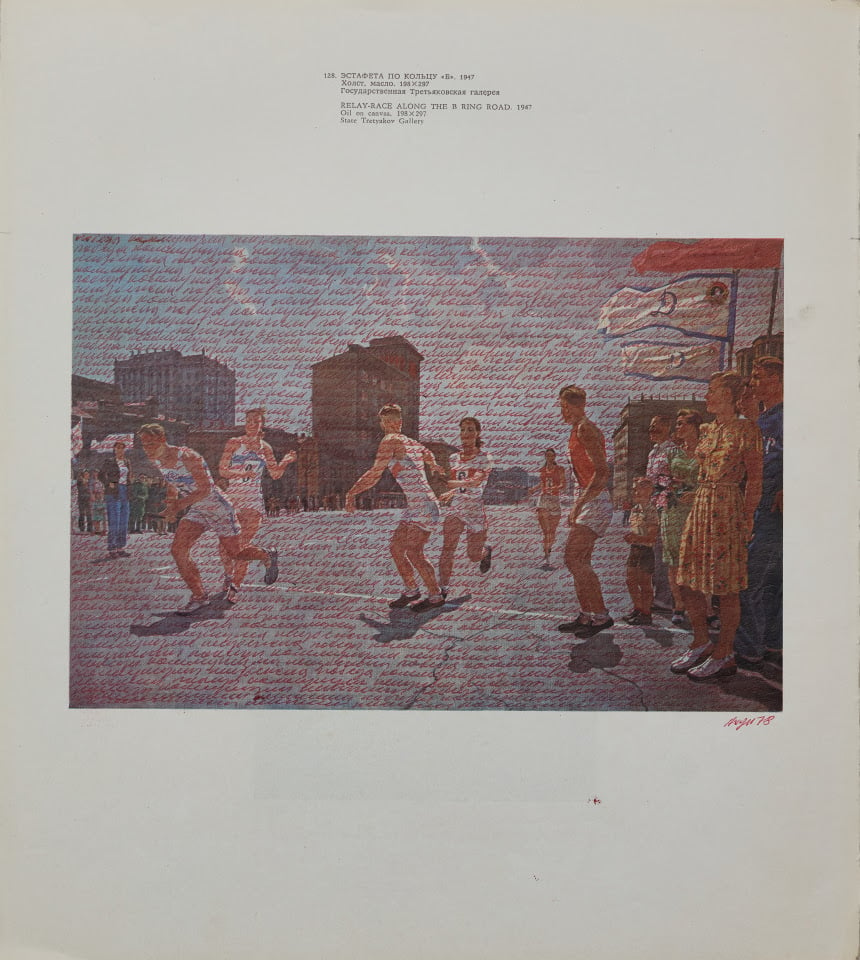
Also looking to the power of repetition, Mantras (1974) features handwritten text layered over mass-produced images taken from Soviet magazines, newspapers, and books. The writing builds up line by line, gradually covering the printed pictures beneath and the text becomes harder to read, eventually merging into a dense surface of marks. This mirrors the repetition of a spoken mantra: over time, individual words lose clarity and turn into rhythm and sound. Meanwhile The Slit (Light at the End of the Path) stages a passage through darkness toward an intense beam of light at its far end—an apparent exit – drawing on the familiar phrase “light at the end of the path.”
Dr Sara Raza, Chief Curator and Artistic Director of the Centre for Contemporary Arts Tashkent, says: “Instruments of the Mind reflects an artistic practice grounded in introspection and spiritual persistence, where meaning accumulates slowly through repetition and return. This exhibition honours both the resilience of a single artistic voice and the wider histories of conceptualism emerging from Central Asia.”
Founded by Gayane Umerova, the CCA Tashkent is the first permanent institution of its kind in Uzbekistan dedicated to contemporary art, research, and community engagement, located in the heart of historic Tashkent. The exhibition, a key milestone in the CCA’s inaugural year of programming, marks an important moment for Akhunov. The artist has lived and worked in both Kyrgyzstan and Uzbekistan, and his career has developed across decades of political and cultural change in the late 20th century.
