


War Rugs | The Nightmare of Modernism the Exhibit
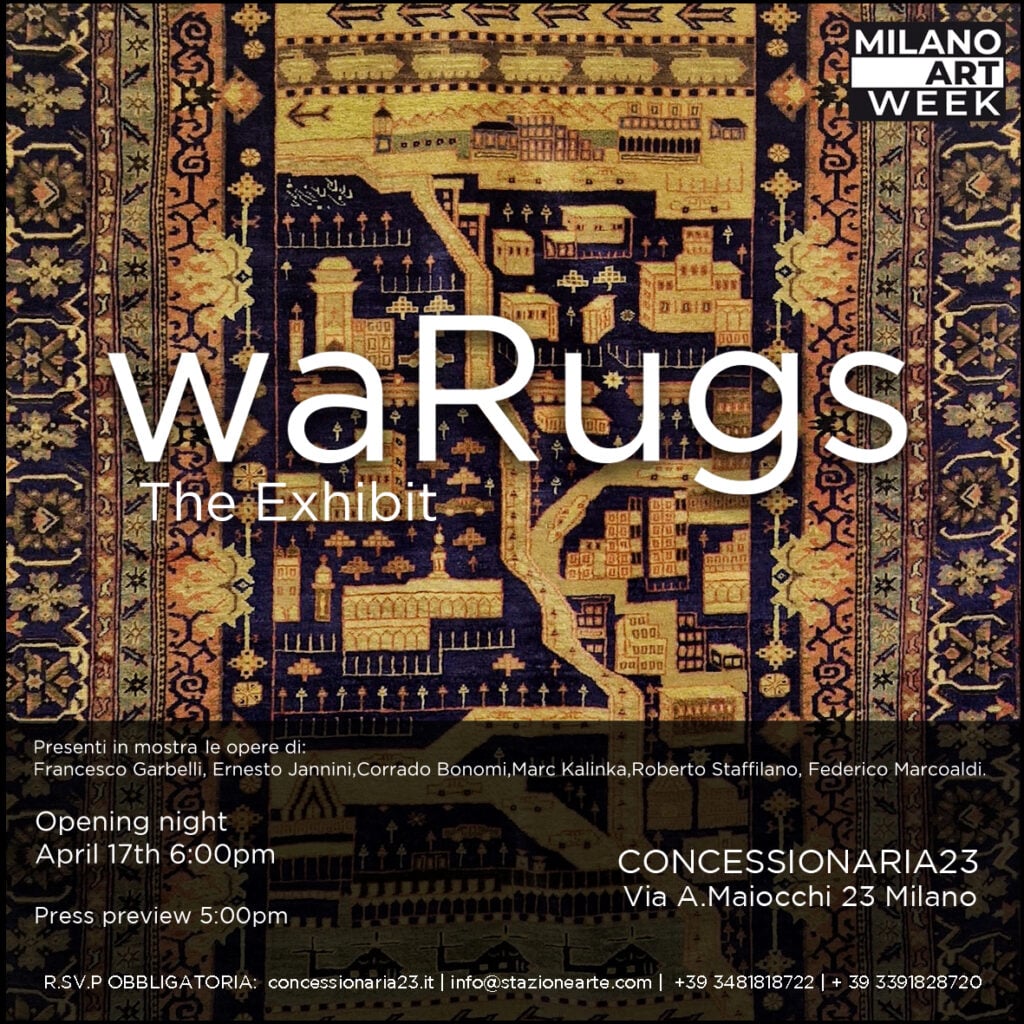
In occasione dell’inaugurazione dei nuovi spazi polifunzionali in via Maiocchi 23, recuperati in uno storico garage degli anni 60, mantenendone il sapore industrial e le caratteristiche strutturali originali , Concessionaria23 è orgogliosa di ospitare per la settimana dell’Arte milanese e del Fuorisalone 2026, per la prima volta a Milano, in un percorso espositivo tutto nuovo, la grande mostra WAR RUGS, Tappeti di Guerra.
Comunicato stampa
INAUGURAZIONE NUOVI SPAZI
CONCESSIONARIA 23 – Via Maiocchi 23 Milano | OPENING NIGHT VENERDI 17 APRILE ORE 18:00
Dal 18 Aprile al 14 Giugno 2026
Evento – Mostra nei circuiti: Milano Art week e Fuorisalone 2026
Concessionaria23
Con la collaborazione di Stazione Arte Contemporary
Presenta:
War Rugs | The Nightmare of Modernism, the Exhibit
Progetto a cura di Enrico Mascelloni, Giovanni Busacca, Concessionaria 23
(Edizione Libro: Skira - War rugs-The nightmare of modernism 2010)
In occasione dell’inaugurazione dei nuovi spazi polifunzionali in via Maiocchi 23, recuperati in uno storico garage degli anni 60, mantenendone il sapore industrial e le caratteristiche strutturali originali , Concessionaria23 è orgogliosa di ospitare per la settimana dell’Arte milanese e del Fuorisalone 2026, per la prima volta a Milano, in un percorso espositivo tutto nuovo, la grande mostra WAR RUGS, Tappeti di Guerra , mostra unica nel suo genere, dal sapore internazionale, che è stata esposta in gallerie europee e musei americani come il rinomato Museum of International Folk Art di Santa Fe in New Mexico.
L’idea, nata dal progetto dei proprietari Antonio e Vincenzo Donadio, la passione e il sapere di Enrico Mascelloni e la curatela artistica di Giovanni Busacca (Owner & Founder di Stazione Arte Contemporary) ci da un segnale chiaro della strada tracciata, da Concessionaria 23, realtà produttiva dinamica che vuole porsi come nuovo polo di riferimento per lo sviluppo di progetti culturali e artistici, per la comunità e la città di Milano.
La mostra dal carattere museale, ci accompagna in un percorso espositivo unico, in un luogo inaspettato, dove i tappeti, installati “crudi” a parete, con il loro forte impatto visivo e forza comunicativa, si integrano perfettamente nell’ambiente freddo, alternati a opere ed istallazioni sul tema, degli artisti contemporanei: Ernesto Jannini, Corrado Bonomi, Roberto Staffilano, Federico Marcoaldi, Marc Kalinka, Francesco Garbelli.
Tema, quello della guerra che è tornato, purtroppo di forte attualità. La mostra, a cura di Giovanni Busacca e Enrico Mascelloni verrà accompagnata dal libro “War rugs-The nightmare of modernism”, edito da SKIRA nel 2010, che ha provocato ampie discussioni non solo tra gli addetti ai lavori e che è ritenuto il più aggiornato e completo resoconto sui Tappeti di Guerra sinora pubblicato.
For info & R.SV.P: [email protected] stazionearte.com | maiocchi23.it
+39 3481818722 | + 39 339 182 8720
LA MOSTRA – WAR RUGS The Exhibit
I tappeti di guerra hanno goduto di notevole fortuna in musei e gallerie d’arte contemporanea, grazie all’originalità e alla tensione innovativa delle rappresentazioni e dei linguaggi, in quanto opere d’arte capaci di toccare le corde più esigenti di una visualità contemporanea che ha bisogno di emozioni forti. I più pregiati sono da tempo ricercati oggetti da collezione. La raccolta in oggetto, realizzata da Enrico Mascelloni in seguito a innumerevoli viaggi in Afghanistan, Pakistan e Asia centrale ex-sovietica, è iniziata alla metà degli anni ’80 e si è avvalsa della collaborazione di numerosi ricercatori, mercanti e specialisti attivi nei luoghi d’origine e in Occidente.
I tappeti sono stati realizzati in Afghanistan e nella Frontiera di Nord-Ovest del Pakistan tra la fine degli anni ’60 e oggi. Dunque tra gli ultimi fasti dell'Hippy Trail, che conduceva molti giovani occidentali verso l'India, in genere via terra, e lo scoppio (1979) della sequenza incessante delle guerre afghane, che ancora perdurano.
Esaminati in articoli divulgativi e saggi specialistici che ormai formano una vasta bibliografia, i tappeti di guerra di alta qualità sono però rari e assai poco visti, appartenendo alla prima fase del periodo preso in esame. La maggior parte delle opere esposte appartiene a tale categoria, sebbene siano incluse alcune di minore qualità tecnica ma capaci di restituire la complessità "pop" di uno tra i più sconvolgenti fenomeni della visualità contemporanea. Accanto alle grandi mappe del mondo con bandiere e sequenze di veicoli militari (così contigue alle celebri "Mappe" di Alighiero Boetti), verranno esposti manufatti più recenti, come il "Tappeto con il Dollaro”.
Altri manufatti rappresentano paesaggi urbani, legati alle aree di provenienza (come Sidney o San Francisco) da cui arrivavano in un Afghanistan ancora pacificato i giovani “frikkettoni” in viaggio verso l'India. Un'altra tipologia ampiamente rappresentata è quella dei “Ritratti”, sia di personaggi storici come Amanullah Khan che di protagonisti della storia contemporanea come il generale Dostum, a loro volta circondati da armi, che in tal caso fungevano da potente simbolismo marziale.
La produzione continua massiccia per tutti gli anni ’80 e ’90. Persino l’ossessiva iconoclastia talebana tollererà la sua rappresentazione. Dopo il 2001 si assiste a una proliferazione di tappeti di guerra di propaganda filo americana, come quello con le due torri in fiamme. La qualità è sempre più scadente, ma la potenza “pop” dell'immagine può arrivare a ideare un tappeto in forma di dollaro e delle dimensioni di una “preghiera”. Chi ci si siederà sopra potrà trovarlo inadeguato agli esercizi spirituali, ma non avrà alcuna difficoltà a sentircisi nell'epoca globale.
"Sono stati necessari altri ritrovamenti per risalire da quel tappeto di guerra che mi aveva sorpreso nella Peshawar della metà degli '80 a una vera e propria tradizione modernista dei decenni precedenti, di cui affiorano di tanto in tanto esemplari sorprendenti, come un tappeto con Geishe e sequenza di aeroplani. Anch'io ero arrivato a ritenere che i tappeti di guerra fossero il portato di un atto collettivo la cui origine, pur recente, era già annegata nel disastro in corso. Ci volle soprattutto la scoperta dei "Tappeti con il mondo" e di altri manufatti non meno sorprendenti per convincermi che i tappeti di guerra erano soltanto l'atto più recente — e in qualche modo di "decadente splendore" — di una produzione modernista che li precedeva di molti anni, in cui le armi moderne figuravano in esemplari che plausibilmente precedevano l'occupazione sovietica." (Mascelloni)
For info & R.SV.P: [email protected] stazionearte.com | maiocchi23.it
+39 3481818722 | + 39 339 182 8720
Musei Americani che hanno ospitato War Rugs in passato.
2021
From Combat to Carpet: The Art of Afghan War Rugs
Museum of International Folk Art
Santa Fe, New Mexico
January 12, 2020–August 3, 2021
2020
From Combat to Carpet: The Art of Afghan War Rugs
Museum of International Folk Art
Santa Fe, New Mexico
January 12, 2020–August 3, 2021
2019
Combat to Carpet: Afghan War Rugs
South Dakota Art Museum, Brookings, South Dakota
August 23/29–November 24, 2019
Afghan War Rugs: The Modern Art of Central Asia
Allen Priebe Gallery, UW-Oshkosh, Oshkosh, Wisconsin
February 21 – March 13, 2019
2018
Afghan War Rugs: The Modern Art of Central Asia
Masur Museum of Art, Monroe, Louisiana
March 14 – June 23, 2018
2017
From Combat to Carpet: The Art of Afghan War Rugs
Lyman Allyn Art Museum, New London, Connecticut
February 17–May 14, 2017
2016
Afghan War Rugs: The Modern Art of Central Asia
Memorial Art Gallery, University of Rochester, New York
August 20–October 16, 2016
2015
Afghan War Rugs: The Modern Art of Central Asia
Scottsdale Museum of Contemporary Art, Scottsdale, Arizona
February 6–April 26, 2015
2014
Afghan War Rugs: The Modern Art of Central Asia
Lawton Gallery, University of Wisconsin, Green Bay, Wisconsin
September 11–October 2, 2014
Afghan Rugs: The Modern Art of Central Asia
Boca Museum of Art, Boca Raton, Florida
May 3–July 22, 2014
2013
Afghan War Rugs: The Modern Art of Central Asia
Villa Terrace Decorative Arts Museum, Milwaukee, Wisconsin
September 20, 2013–January 6, 2014
INAUGURATION OF NEW SPACES
CONCESSIONARIA 23 – Via Maiocchi 23 Milano | OPENING NIGHT FRIDAY APRIL 17, 18:00
From April 18 to June 14, 2026
Event – EXHIBITION in the circuits: Milano Art week and Fuorisalone 2026
Concessionaria23
In collaboration with Stazione Arte Contemporary
Presents:
War Rugs | The Nightmare of Modernism, the Exhibit
Project curated by Enrico Mascelloni, Giovanni Busacca, Concessionaria 23
(Book Edition: Skira - War rugs-The nightmare of modernism 2010)
On the occasion of the inauguration of the new multipurpose spaces at Via Maiocchi 23, recovered from a historic 1960s garage while preserving its industrial character and original structural features, Concessionaria23 is proud to host, during Milan Art Week and Fuorisalone 2026, for the first time in Milan in a brand new exhibition layout, the major show WAR RUGS: a one-of-a-kind exhibition with an international flavour, which has been displayed in European galleries and American museums such as the renowned Museum of International Folk Art in Santa Fe, New Mexico.
The idea, born from the project of the owners Antonio and Vincenzo Donadio, the passion and expertise of Enrico Mascelloni, and the artistic curation of Giovanni Busacca (Owner & Founder of Stazione Arte Contemporary), gives a clear signal of the direction set by Concessionaria23, a dynamic and productive reality that aims to establish itself as a new point of reference for the development of cultural and artistic projects for the community and the city of Milan.
The exhibition, with its museum-like character, takes us on a unique journey through an unexpected space, where the rugs — displayed "raw" on the walls — with their strong visual impact and communicative power, blend seamlessly into the raw industrial environment, alternating with works and installations on the same theme by contemporary artists: Ernesto Jannini, Corrado Bonomi, Roberto Staffilano, Federico Marcoaldi, Marc Kalinka, and Francesco Garbelli.
The theme of war has, unfortunately, become a highly topical issue once again. The exhibition, curated by Giovanni Busacca and Enrico Mascelloni, will be accompanied by the book “War Rugs—The Nightmare of Modernism” (published by SKIRA in 2010). The volume sparked extensive debate far beyond specialized circles and is considered the most up-to-date and comprehensive account of War Rugs published to date.
For info & R.S.V.P.: [email protected] stazionearte.com | maiocchi23.it
+39 3481818722 | + 39 339 182 8720
THE COLLECTION – WAR RUGS The Exhibit
War rugs have achieved considerable success in contemporary art museums and galleries, thanks to the originality and innovative tension of their representations and visual languages, as artworks capable of striking the most demanding chords of a contemporary sensibility that needs strong emotional stimuli. The finest examples have long been sought-after collector's items. The collection was assembled by Enrico Mascelloni after countless trips to Afghanistan, Pakistan, and the former Soviet Central Asia, beginning in the mid-1980s and has benefited from the collaboration of numerous researchers, dealers, and specialists active both in the countries of origin and in the West.
The rugs were made in Afghanistan and the North-West Frontier of Pakistan between the late 1960s and the present day, spanning the final flourishing of the Hippy Trail, which led many young Westerners towards India, generally overland, and the outbreak (1979) of the unceasing sequence of Afghan wars that continues to this day.
Examined in popular articles and specialized essays that now form a vast bibliography, high-quality war rugs are nonetheless rare and seldom seen, since they belong to the initial phase of the period under consideration, as do most of the works on display in this exhibition. However, we found it appropriate to include some of lower technical quality that are nonetheless capable of conveying the "pop" complexity of one of the most astonishing phenomena in contemporary visual culture. Alongside large world maps surrounded by the flags of their respective countries and sequences of military vehicles (so closely related to Alighiero Boetti’s famous Mappe), more recent artifacts will be exhibited, such as the "Dollar Rug." Other pieces depict urban landscapes linked to the areas of origin (such as Sydney or San Francisco) from which young "hippies" arrived in a still-peaceful Afghanistan during their journeys toward India. Another widely represented category is that of "Portraits," featuring both historical figures like Amanullah Khan and protagonists of contemporary history like General Dostum, each surrounded by weapons, which in this context served as potent martial symbolism.
Production continued on a massive scale throughout the 1980s and 1990s. Even the obsessive Taliban iconoclasm tolerated its representation. After 2001, a proliferation of pro-American propaganda war rugs emerged, such as the one depicting the Twin Towers in flames. Quality became increasingly poor, yet the "pop" power of the imagery could go so far as to conceive a rug in the shape of a dollar bill, the size of a prayer mat. Whoever sits on it may find it ill-suited to spiritual exercises, but will have no difficulty feeling at home in the global age.
"Further discoveries were needed to trace back from that war rug that had surprised me in the Peshawar of the mid-1980s to a genuine modernist tradition rooted in the preceding decades, from which remarkable specimens occasionally surfaced — such as a rug featuring Geishas and a sequence of aeroplanes. I too had come to believe that war rugs were the product of a collective act whose origin had already been swallowed up by the disaster unfolding around it. Yet the discovery of the 'Rugs with the World' and other no less surprising artefacts convinced me that war rugs were merely the most recent act — and in some ways one of 'decadent splendour' — of a modernist production that had preceded them by many years, in which modern weapons appeared across many examples that plausibly pre-dated the Soviet occupation." (Mascelloni)
For info & R.S.V.P.: [email protected] stazionearte.com | maiocchi23.it
+39 3481818722 | + 39 339 182 8720
American Museums that have previously hosted War Rugs.
2021
From Combat to Carpet: The Art of Afghan War Rugs
Museum of International Folk Art
Santa Fe, New Mexico
January 12, 2020–August 3, 2021
2020
From Combat to Carpet: The Art of Afghan War Rugs
Museum of International Folk Art
Santa Fe, New Mexico
January 12, 2020–August 3, 2021
2019
Combat to Carpet: Afghan War Rugs
South Dakota Art Museum, Brookings, South Dakota
August 23–November 24, 2019
Afghan War Rugs: The Modern Art of Central Asia
Allen Priebe Gallery, UW-Oshkosh, Oshkosh, Wisconsin
February 21 – March 13, 2019
2018
Afghan War Rugs: The Modern Art of Central Asia
Masur Museum of Art, Monroe, Louisiana
March 14 – June 23, 2018
2017
From Combat to Carpet: The Art of Afghan War Rugs
Lyman Allyn Art Museum, New London, Connecticut
February 17–May 14, 2017
2016
Afghan War Rugs: The Modern Art of Central Asia
Memorial Art Gallery, University of Rochester, New York
August 20–October 16, 2016
2015
Afghan War Rugs: The Modern Art of Central Asia
Scottsdale Museum of Contemporary Art, Scottsdale, Arizona
February 6–April 26, 2015
2014
Afghan War Rugs: The Modern Art of Central Asia
Lawton Gallery, University of Wisconsin, Green Bay, Wisconsin
September 11–October 2, 2014
Afghan Rugs: The Modern Art of Central Asia
Boca Museum of Art, Boca Raton, Florida
May 3–July 22, 2014
2013
Afghan War Rugs: The Modern Art of Central Asia
Villa Terrace Decorative Arts Museum, Milwaukee, Wisconsin
September 20, 2013–January 6, 2014
