

Jennifer West – Stitched Cosmos
Mostra personale.
Comunicato stampa
Ahead of her solo presentation, Stitched Cosmos, at Ca’ Foscari University of Venice on the occasion of the 61st Biennale Arte, Francesco Urbano Ragazzi celebrates the announcement of artist Jennifer West as a 2026 Guggenheim Fellow.
Featuring 223 distinguished individuals working across 55 disciplines, the Guggenheim Foundation’s 101st Class of Fellows taps 223 trailblazing artists, scientists and scholars across 55 fields.
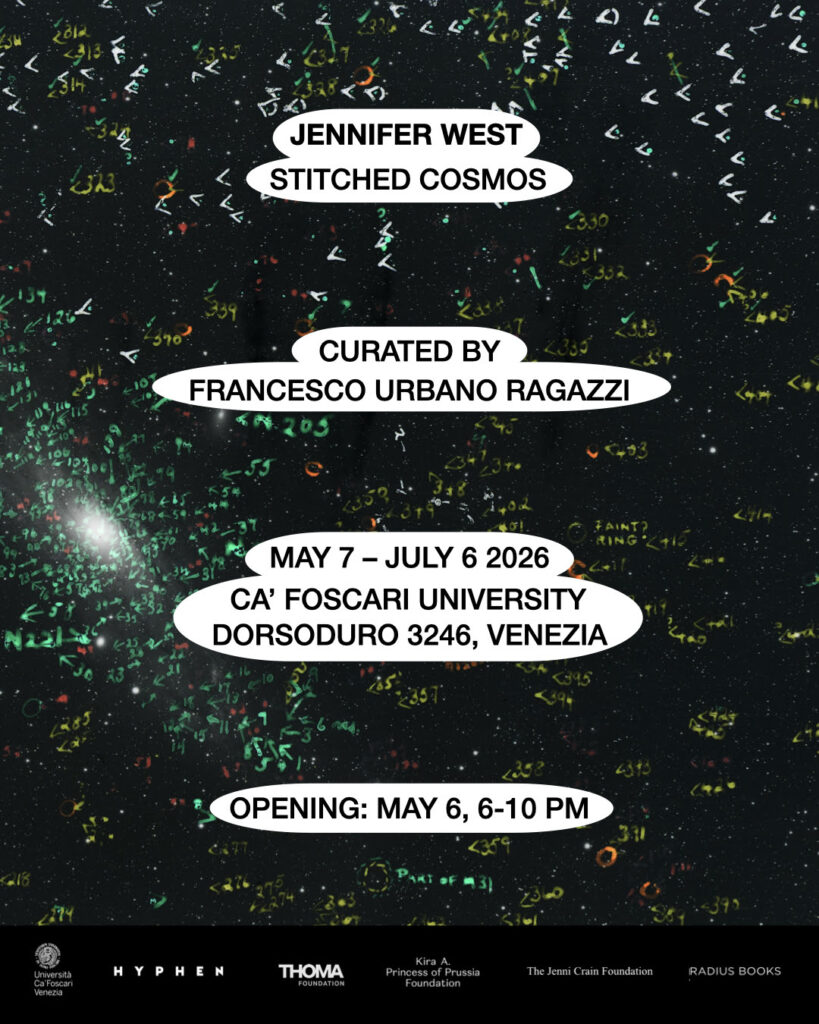
Jennifer West - also recipient of a Smithsonian Artist Research Fellowship 2025-2026 - presents Stitched Cosmos at Ca’ Foscari University of Venice, in the Dorsoduro district, from 7 May - 6 July 2026.
Integrating with the institution’s daily activities, the exhibition transforms the ground floor of the city’s oldest university, like an alien object, into a psychedelic device for contemplating the cosmos, thanks to the work the artist has carried out on the invaluable collection of the Harvard Plate Stacks at the Harvard Smithsonian Center for Astrophysics.
Through a new environmental installation, artist Jennifer West celebrates the often overlooked yet fundamental work of a group of women scientists known as the Harvard Astronomical Computers, reclaiming the role of scientific research at a time when it appears to be defunded and under attack.
Stitched Cosmos marks the first public presentation of the research Jennifer West conducted as part of the Artist Research Fellowship awarded to her last year by the Smithsonian Institution, the largest museum, education, and research complex in the world.
In the months leading up to the exhibition, the Los Angeles–based artist worked directly with materials from the Astronomical Plate Collection, now held at the Harvard-Smithsonian Center for Astrophysics. The collection comprises over 500,000 glass plates bearing as many images of the universe. Prepared to function as photographic negatives, the surfaces of these plates have captured light traveling from distant galaxies through the lenses of telescopes, giving tangible form to light-year distances. This particular photographic technique was used systematically from the 1870s through the 1990s, when algorithmic imaging technologies began to take hold. The plates thus represent a pivotal moment in the transition from analog to digital image production, a central concern within the artist’s three-decade-long career.
The archaeology of science, however, is only one dimension of Jennifer West’s inquiry. Each glass plate also bears a multitude of multicolored annotations, still clearly legible today. These marks are the result of the meticulous labor of the Harvard Astronomical Computers, a group of women scientists known by this designation at a time when the term computer referred not to a machine but to the job title of individuals performing complex calculations. Hired in part because their labor was less costly than that of their male counterparts, these women went on to revolutionize astrophysics. From a position of limited recognition, they developed a system for classifying celestial objects that remains in use worldwide. By reworking the drawings, images, and annotations produced by these women, Jennifer West pays tribute to all forms of female labor that have long gone unrecognized, within science as well as across other domains of human culture.
WHY STITCHED COSMOS AT CA’ FOSCARI UNIVERSITY?
Jennifer West’s exhibition forms part of an ongoing series curated by the duo Francesco Urbano Ragazzi on the occasion of the Biennale Arte in Venice since 2015. Each iteration unfolds within historically significant sites across the city, where cultural memory intersects with the structures and uses of contemporary life. The series includes The Internet Saga by Jonas Mekas at Palazzo Foscari Contarini, now a fast-food restaurant (2015); Hillary: The Hillary Clinton Emails by Kenneth Goldsmith at the Cinema Teatro Italia, now a supermarket (2019); and Adoration by Pauline Curnier Jardin at the Convent of the Convertite, currently home to the Giudecca women’s prison (2022).
The series positions Venice as a paradigmatic case through which to examine the global dynamics of touristification and gentrification, while advancing more sustainable models of cultural production.If earlier chapters brought into focus spaces shaped by consumption and control, this iteration marks a shift toward an institution devoted to the production and transmission of knowledge. In this context, Francesco Urbano Ragazzi identifies research centers such as Ca’ Foscari University as catalysts for ongoing generational renewal—sites where critical thought is cultivated and where cities and territories can reimagine the terms of their own future.
THE EXHIBITION:
During her residency at the Harvard-Smithsonian Center for Astrophysics, Jennifer West turned her attention to a group of fractured and damaged plates, whose data has been lost. By re-photographing and filming their surfaces, she translates these time-worn images into multiple media, reactivating them and dispersing their latent energy into a kaleidoscopic field of proliferating fragments.
Greeting the viewer from the very entrance of the exhibition is a series of luminous diptychs. Mounted on Hyphen modular sets –typically used for product photography–are a number of collages in which stars, galaxies, and nebulae overlap to form an intricate cosmology. These compositions bring into dialogue the images impressed on the Harvard Plate Stacks with those captured by today’s most advanced satellite telescopes. This visual process is further set in motion through a series of animations displayed on screens arranged both horizontally and vertically throughout the exhibition space and featuring music by the Japanese band Open Reel Ensemble. In addition, holographic projections lend a three-dimensional presence to these sublime celestial representations.
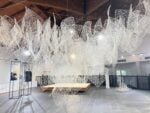
Finally, the building’s water gate hosts a monumental yet weightless cinematic installation. Suspended against the glass windows at the far end of the hall are large quilts made of film strips, intricately stitched into patterns. Frames in 16, 35, and 70 mm hand-inked with the color-coding system the women computers used, intersect to form star-shaped patterns, an iconic motif within the American quilting tradition. At the center is an oversized quilt blocked spiral, echoing the many spiral galaxies that were studied and marking the architecture in the style of the Barn Quilt. As natural light filters through the glass, the work refracts into shards of luminosity. Its refined craftsmanship pays tribute to the meticulous labor of the Harvard Astronomical Computers, transforming the university’s atrium into a magic lantern.
Stitched Cosmos turns Ca’ Foscari University into a field of attraction between opposites. The works on view stage both the convergence and the tension between distinct aesthetics and epistemologies: analog and digital, drawing and photography, art and science, manual labor and theory. What emerges is a vision of human knowledge that dissolves disciplinary boundaries to engage with the outer limits of the known universe.
About the artist:
Jennifer West (b. 1966, Topanga, CA) is a Los Angeles-based artist who has explored the materiality of film for over two decades. Her work spans large-scale moving image installations and site-specific interventions, with major projects commissioned by the Turbine Hall at Tate Modern, the High Line in New York, Frieze Los Angeles, LIAF Biennial, MIT List Visual Arts Center, Aspen Art Museum, among others.
In 2022, Radius Books published Jennifer West: Media Archaeology, launched at the Centre Pompidou in Paris on the occasion of Typofilm: Jennifer West. Her work has been presented in solo exhibitions at the Centre Pompidou, Times Square Arts, Yuz Museum in Shangai, Seattle Art Museum, S1 Artspace in Sheffield (UK), Kunstverein Nürnberg (Germany), Contemporary Arts Museum Houston, Contemporary Art Museum St. Louis, Joan Los Angeles, Tramway Glasgow, White Columns in New York, and included in major group exhibitions at the Barbican in London, CAPC in Bordeuax, France, Kunsthalle Schirn in Frankfurt, ZKM in Karlsruhe, the Whitney Museum and the Drawing Center in New York.
Her work is held in leading public collections including LACMA, the Hammer Museum, the Getty Museum, Kadist, MONA (Museum of Old and New Art), MOCA Los Angeles, the Thoma Collection, Rubell Collection, the Saatchi Collection and others. She is a 2025–2026 Smithsonian Artist Research Fellow.
About the curators:
Francesco Urbano Ragazzi is a curatorial duo founded in Paris in 2008 by Francesco Ragazzi (PhD) and Francesco Urbano (PhD). Their practice reconnects art with reality through exhibitions that extend beyond galleries and museums, exploring a broader concept of public space. Their approach is exemplified by a trilogy of exhibitions curated in Venice on the occasion of the Biennale: “The Internet Saga” by Jonas Mekas (2015); “Hillary: The Hillary Clinton Emails” by Kenneth Goldsmith, with the participation of Hillary Rodham Clinton (2019); and “Adoration” by Pauline Curnier Jardin and the inmates of the Giudecca detention house (2022). The duo has also developed projects for major institutions worldwide, including the MMCA (Seoul), School of Visual Arts, ISCP (New York), Kunstnernes Hus (Oslo), CERN (Geneva), Maraya Art Centre (Sharjah), Centro Ricerca Castello di Rivoli (Turin), Reykjavik International Film Festival, Centre d’Art Contemporain Genève, La Loge (Brussels), La Casa Encendida (Madrid), Institut Français (Paris), Ikon (Birmingham), Ruya Foundation (Baghdad). In the last five years, they co-edited FUORI!!! 1971–1974, an award-winning anthology dedicated to the first LGBTQ+ magazine in Italian history; they directed the 17th LIAF Biennial in Norway; and curated “Jonas Mekas 100!” in Italy, the international program celebrating the centenary of the legendary filmmaker, with whom they had long collaborated. In 2025, Francesco Urbano Ragazzi was named the first Italian curatorial fellow at the American Academy in Rome.
Exhibition Partners:
Stitched Cosmos is supported by Hyphen-Group and the Carl & Marilynn Thoma Foundation, with the generous contribution of Justine Alexandria Tek on behalf of Yuz Foundation, the Kira A. Princess of Prussia Foundation and the Jenni Crain Foundation, an initiative dedicated to preserving the legacy of the esteemed artist and curator. The research has been funded by the Smithsonian Artist Research Fellowship 2025–2026 and the University of Southern California’s Advancing Scholarship in the Humanities and Social Sciences Research and Creative Project Grant 2025–2026.
Media partner: Radius Books.
