


Amelia
Comunicato stampa
The exhibition Amelia, currently on view at our Piacenza venue, travels to UNA | Milano for a ten-day pop-up show.
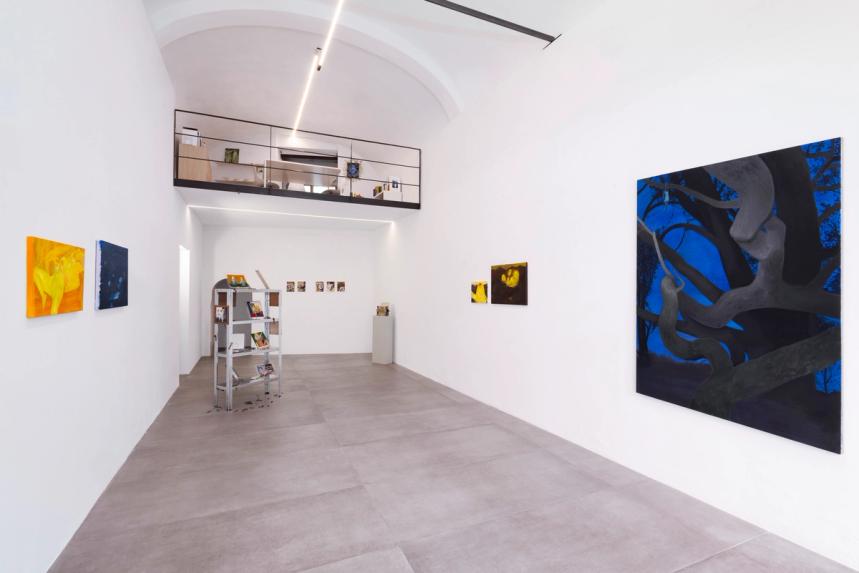
Amelia - inspired by Amelia Earhart, nonconformist and visionary aviator from the early 1900s - brings together the work of a young generation of artists: Beatrice Alici (1992, San Donà di Piave, IT), Lula Broglio (1993 Imperia, IT), Anaïs Horn (Graz, Austria), and Amalia Vekri (Athens). Their practices explore the representation of the female body in its many forms: a body suspended between the desire for self-representation and self-reflection, and the intrusion of an external gaze that defines its parameters and characteristics. It is a body that merges with natural, fantastical, monstrous, and vampiric elements, inviting us to question how it has been constructed and represented throughout the history of art, cinema, and literature, as well as in contemporary advertising and digital media. This body moves between public and private, domestic, real, and virtual spaces, continually negotiating its identity and independence. With a text by Chiara Nuzzi.
Through oil painting, Beatrice Alici creates a richly layered feminine universe shaped by mythology, the supernatural, and folklore. Her figures—appearing as goddesses or witches—evoke a lost matriarchal world governed by queens and priestesses devoted to a Great Goddess. Often set in nocturnal scenes where blues, greens, and reds glow under moonlight, her works inhabit a space between the sacred and the profane, as surreal and enigmatic as their protagonists. Lula Broglio presents a series of small-format works from the Musicians series: intimate portraits in which each face is captured in the very moment of performance, fully absorbed in the act. The instrument remains unseen, leaving open the nature of the gesture that produces such intensity of perception and emotional presence. Arranged like a visual score, the works resonate with one another through the recurring presence of insects—mainly butterflies—symbols of transformation and of the connection between the female figure and the natural world. Anaïs Horn’s project The Call of the Void consists of a series of found vintage auction photographs depicting furniture and decorative objects, onto which the artist intervenes by painting evanescent female figures and surreal scenarios that seem to emerge from these abandoned spaces, as if the furnishings retained traces of past lives and gestures. In her work, the home—and the female figure inhabiting it—is never neutral: it is a reservoir of desire, memory, and estrangement. Amalia Vekri’s paintings begin with images already in circulation. The archetype underneath — the figure that persists across contexts, recognizable before it is understood — is what she is after. Her women are vampires, witches, spectral presences, not as mythological illustrations but as evidence of how femininity gets scripted and diffused through visual culture. Colour is where this pressure becomes most visible. Hot and corrosive or bleached to near-disappearance, colour registers the logic of desirability — flesh as something to be consumed, preserved, or feared. The bodies in these paintings are initially seductive, even polished. The threat emerges slowly: something monstrous at the edge of the fetishised, the coveted tipping into the repulsive.
