
Alessandro Aprile – Abissura
Mostra personale.
Comunicato stampa
Non c’è orizzonte a cui tendere, non c’è fondo su cui poggiare.
In questo spazio non esistono coordinate, ma una promessa di equilibrio sospesa in un campo di forze compresse.
Abitarlo, significa farsi carico di tutto il loro peso per poterne emergere. Solo ciò che è in grado di resistere, può sopravvivere.
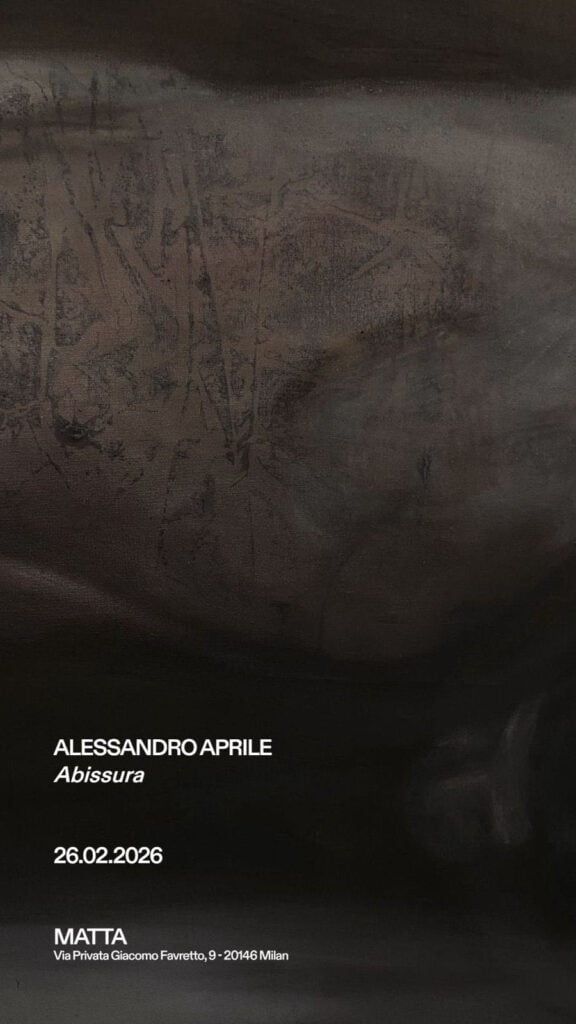
Il monotipo registra l’inizio di questa sedimentazione: imprime e fissa tracce che non restituiscono un orientamento, ma si depositano in una prima trama senza narrazione dove ciò che resta è puro contatto, per attrito. Qui, la monumentalità, da attributo può diventare attitudine: una pratica di esposizione al limite, dove la forma si costituisce per la sua capacità di sostenere l’instabilità dello spazio che la contiene.
Rinunciare a punti di controllo; lasciare che prima il gesto, e poi lo sguardo, non abbiano appigli, né spazi sicuri. Trattenere senza mai rilasciare. Il fiato è sospeso, la tensione obbliga a sostare.
Nel tempo, ciò che resiste alla dispersione, prende corpo fino a farsi paesaggio. Le figure emergono come differenti stati di questa condizione: immerse in una pressione che non concede deviazioni, diventano l’unico orientamento possibile. Incombono come l’ombra del peso che portano, non si lasciano risolvere. Nel loro abisso, tengono tutto nascosto. La quiete che sostengono, ed al tempo stesso combattono, è una soglia instabile; la sensazione per cui nulla possa compiersi definitivamente. Non si espira.
La loro forma può solo esistere come ciò che galleggia nella profondità dell’acqua ferma: senza esito, ma in attesa. Un continuo ritorno alla promessa di equilibrio, senza un centro che possa reggere.
-
There is no horizon to strive for, no bottom to rest on.
In this space there are no coordinates, but a promise of balance suspended in a field of compressed forces.
To inhabit it means to take on all their weight in order to emerge. Only those who are able to resist can survive.
The monotype records the beginning of this sedimentation: it imprints and fixes traces that do not provide orientation, but are deposited in a first narrative-free plot where what remains is pure contact, through friction. Here, monumentality, as an attribute, can become an attitude: a practice of exposure to the limit, where form is constituted by its ability to sustain the instability of the space that contains it.
Renouncing control points; allowing first the gesture, and then the gaze, to have no footholds, no safe spaces. Holding back without ever releasing. Breath is suspended, tension forces us to pause.
Over time, what resists dispersion takes shape until it becomes landscape. The figures emerge as different states of this condition: immersed in a pressure that allows no deviation, they become the only possible orientation. They loom like the shadow of the weight they carry, refusing to be resolved. In their abyss, they keep everything hidden. The stillness they sustain, and at the same time fight against, is an unstable threshold; the feeling that nothing can be definitively accomplished. There is no exhalation.
Their form can only exist as something floating in the depths of still water: without outcome, but waiting. A continuous return to the promise of balance, without a center that can hold.
-
