
Vít Pavlík / Cecilia Chiavistelli
Sincresis presenta Anima mundi di Vít Pavlík e Geografie dell’invisibile di Cecilia Chiavistelli, due mostre in concomitanza.
Comunicato stampa
Sincresis presenta Anima mundi di Vít Pavlík e Geografie dell’invisibile di Cecilia Chiavistelli, due mostre in concomitanza che, pur nascendo da percorsi artistici autonomi, trovano nella pittura un comune territorio di ricerca basandosi su paesaggio, memoria e esperienza individuale che si incontrano fino a rendere incerti i confini tra ciò che appartiene al mondo esterno e ciò che invece prende forma dentro se stessi.
Una storia precede queste due mostre e riguarda proprio la possibilità dell'incontro. Cecilia Chiavistelli, nata a Poggibonsi, e Vít Pavlík, nato a Volary, nella regione della Šumava, provengono da due luoghi geograficamente lontani, ma nel corso degli anni i loro percorsi artistici si sono incrociati più volte. La loro relazione si è sviluppata anche attraverso il Volarismus, esperienza artistica testimoniata da un manifesto nata a Volary e fondata da Vit insieme ad altri artisti, tra cui Cecilia che ha agito come tramite permettendogli di conoscere Sincresis e di proporre un progetto nel’ambito del nostro programma di residenza.
Poggibonsi e Volary diventano così due coordinate reali, due luoghi di origine che permettono di leggere in una prospettiva più ampia il senso di questo doppio appuntamento. La distanza geografica tra Toscana e Boemia è attraversata da una rete di relazioni possibili, incontri, viaggi e scambi che nel tempo ha costruito una geografia diversa da quella delle mappe, costituita da persone e da esperienze, per cui un luogo può condurre a un altro e un incontro può diventare il punto di partenza per un nuovo percorso. È in questo spazio intermedio, tra memoria e scoperta, che le nuove opere possono trovare la propria forma.
La pittura di Vít Pavlík nasce da un luogo preciso, la Šumava, la Foresta Boema nella quale l'artista è nato e cresciuto, ma il luogo di origine entra nel corpo e nella mente dell'artista e diventa memoria, ritmo, energia; giunge in profondità, per cui gli elementi naturali, l’ acqua, la terra, la luce, liberandosi progressivamente dalla rappresentazione, si trasformano, attraverso i moti interiori, in colore, gesto e movimento. Ciò che esprimono le opere non è tanto l'immagine della natura quanto l’interiorizzazione di una esperienza che viene reimmaginata.
Le opere di Pavlík sembrano così muoversi continuamente tra il riconoscibile e l'astratto, tra la forma e la sua dissoluzione. Le pennellate, spesso energiche e dinamiche unitamente agli effetti di textures ottenuti con pittura acrilica spray sul fondo della tela, tentano di restituire la sua incessante vibrazione e la natura appare come una forza vitale della quale l'essere umano non è spettatore esterno, ma parte integrante.
È in questo senso che Anima mundi può essere letta come una chiave per entrare nella ricerca dell'artista. L'antica idea di un'anima del mondo, di un principio capace di attraversare e mettere in relazione tutte le cose, trova nella pittura di Pavlík una forma sensibile. L’artista ricerca un contatto all’unisono con il cosmo, tenta di alimentare la sua ‘anima’ individuale tramite le energie dell’universo, che si esprimono nel colore, nel gesto, nella materia come aspetti pulsanti di un medesimo organismo in modificazione continua. La pittura diventa il luogo nel quale questa continuità può essere intuita, senza necessità di definizioni che comporterebbero un limite e una chiusura.
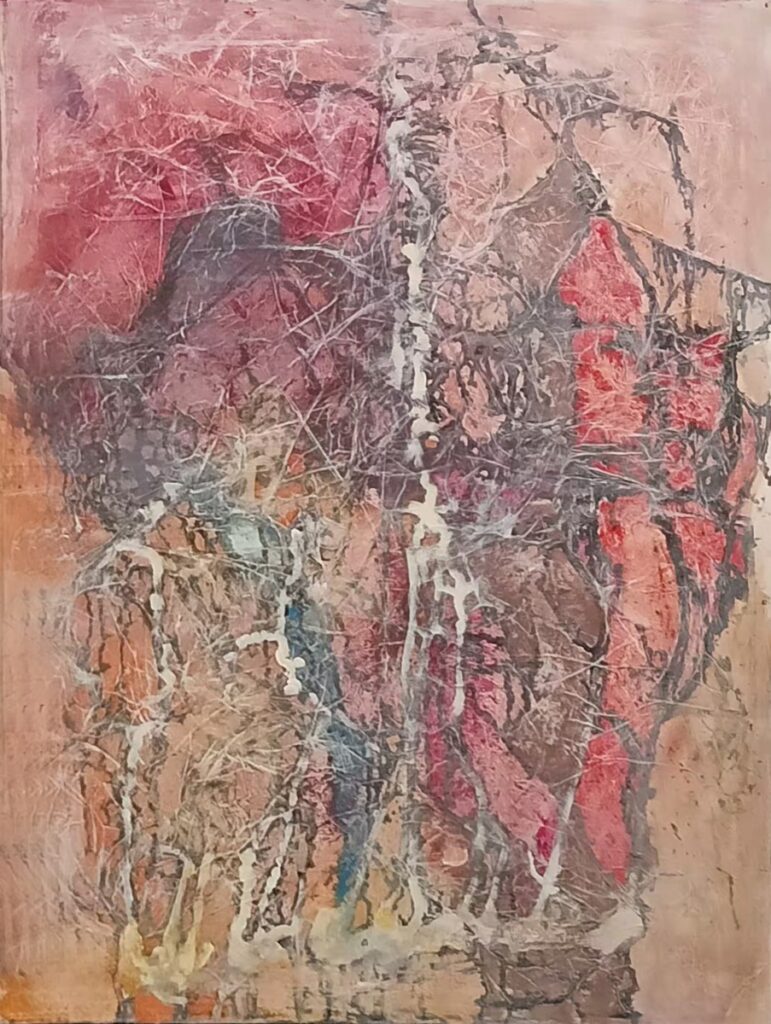
Nella ricerca di Cecilia Chiavistelli il segno costruisce territori che non possono essere ricondotti a una geografia convenzionale. Intrichi, sovrapposizioni, addensamenti e gorghi di materia generano superfici che evocano mappe, trame organiche, percorsi, stratificazioni. La pittura sembra procedere per accumulo e per sedimentazione, come se ogni gesto conservasse la memoria di quelli precedenti. Il territorio viene ricostruito attraverso una materia cromatica che ne restituisce la complessità e l’invisibile profondità. Le sue opere suggeriscono che ogni luogo possiede una dimensione nascosta, fatta di tracce e di presenze che non possono essere fissate attraverso coordinate geografiche, ma che riemergono dall’interiorità attraverso il gesto pittorico.
Il titolo Geografie dell’invisibile nasce proprio da questa tensione, in quanto la geografia tradizionale individua, misura, delimita; quella evocata dalla pittura di Cecilia procede invece attraverso ciò che non può essere misurato: la memoria di un luogo, la percezione del tempo, l'esperienza di chi lo attraversa. La superficie diventa così una mappa senza legenda, nella quale lo sguardo è chiamato a inoltrarsi, seguendo i percorsi imprevedibili del segno e della materia.
La residenza di Pavlík presso Sincresis introduce a questo dialogo un ulteriore elemento: lo spostamento. L'artista arriva in Toscana portando con sé il proprio paesaggio originario e si confronta con un territorio nuovo.
Anche la presenza di Cecilia accanto a Pavlík assume significanza, poiché nella sua storia personale e artistica da diversi anni viaggia dalla Toscana alla Repubblica Ceca e anche verso altri paesi dell’est per motivi artistici, e il suo rapporto con Pavlík rappresenta concretamente uno dei fili attraverso i quali queste due geografie sono entrate in contatto. Se Poggibonsi e Volary sono i luoghi dai quali i due artisti provengono, Sincresis diventa il luogo nel quale le loro traiettorie si incontrano nuovamente.
Le mostre diventano così anche il risultato di tutto ciò che non è immediatamente visibile nelle opere: i percorsi che le hanno precedute, le relazioni che le hanno rese possibili, i luoghi attraversati, le persone incontrate. Due ricerche differenti orientate verso un unico linguaggio, ma con la consapevolezza che l'arte possa costruire connessioni là dove la geografia sembrerebbe stabilire separazioni, mente cancella le distanze e alimenta prossimità e un legame di amicizia. La pittura di Cecilia Chiavistelli e quella di Vít Pavlík ci invitano a sostare in questa zona di confine, dove il segno diventa memoria, la materia diventa esperienza tra esperienza e memoria, tra visibile e invisibile, tra due artisti e le geografie che li hanno formati.
È forse questo il filo invisibile che unisce Anima mundi e Geografie dell’invisibile. I luoghi continuano a vivere nelle persone che li hanno abitati; le persone, a loro volta, diventano strumenti attraverso i quali i luoghi possono incontrarsi.
Le due mostre trovano il loro punto di maggiore vicinanza: nell'idea che ciò che vediamo non esaurisca mai ciò che un luogo, una persona o un'opera possono contenere.
Sincresis diventa così, per un tempo, un luogo di convergenza tra esperienza e memoria, tra visibile e invisibile, tra due artisti e le geografie che li hanno formati. Rimane una traccia, una forma di appartenenza, forse, semplicemente, quel filo invisibile che continua a unire ciò che la distanza non è riuscita a separare.
Sincresis presents Anima mundi by Vít Pavlík and Geographies of the Invisible by Cecilia Chiavistelli, two concurrent exhibitions which, while emerging from distinct artistic paths, find in painting a shared field of investigation, rooted in landscape, memory, and individual experience. These elements come together to the point of blurring the boundaries between what belongs to the external world and what takes shape within us.
A story precedes these two exhibitions and concerns precisely the possibility of encounter. Cecilia Chiavistelli, born in Poggibonsi, and Vít Pavlík, born in Volary, in the Šumava region, come from two geographically distant places, yet their artistic paths have crossed several times over the years. Their relationship also developed through Volarismus, an artistic experience documented by a manifesto, which originated in Volary and was founded by Vít together with other artists, including Cecilia. She acted as a link, enabling him to discover Sincresis and to propose a project as part of our residency programme.
Poggibonsi and Volary thus become two real coordinates, two places of origin that allow this double exhibition to be understood from a broader perspective. The geographical distance between Tuscany and Bohemia is crossed by a network of possible relationships, encounters, journeys, and exchanges that, over time, has created a geography different from that of maps: one made up of people and experiences, in which one place can lead to another and an encounter can become the starting point for a new journey. It is within this space between memory and discovery that the new works can take shape.
Vít Pavlík’s painting originates in a specific place: the Šumava, the Bohemian Forest, where the artist was born and raised. Yet this place of origin enters the artist’s body and mind and becomes memory, rhythm, and energy; it reaches deep within him, so that natural elements such as water, earth, and light, gradually freed from representation, are transformed through inner impulses into colour, gesture, and movement. What the works express is therefore not so much the image of nature as the internalisation of an experience that is subsequently reimagined.
Pavlík’s works thus seem to move continuously between the recognisable and the abstract, between form and its dissolution. His often energetic and dynamic brushstrokes, together with the textured effects created by acrylic spray paint on the canvas ground, seek to convey the incessant vibration of nature, which appears not as an external setting but as a vital force of which the human being is an integral part.
It is in this sense that Anima mundi can be understood as a key to entering Pavlík’s artistic research. The ancient idea of a world soul, a principle capable of permeating and connecting all things, finds a tangible form in his painting. The artist seeks a harmonious connection with the cosmos, attempting to nourish his individual “soul” through the energies of the universe, expressed through colour, gesture, and matter as pulsating aspects of a single organism in constant transformation. Painting becomes the place in which this continuity can be sensed, without the need for definitions that would impose limits and closure.
In Cecilia Chiavistelli’s work, the mark constructs territories that cannot be reduced to a conventional geography. Interweavings, superimpositions, accumulations, and swirling masses of matter generate surfaces that evoke maps, organic patterns, pathways, and layers of sedimentation. Painting seems to proceed through accumulation and stratification, as though each gesture preserved the memory of those that preceded it. The territory is reconstructed through chromatic matter that conveys not only its complexity but also its invisible depth. Her works suggest that every place possesses a hidden dimension, made up of traces and presences that cannot be fixed through geographical coordinates, but re-emerge from within through the act of painting.
The title Geographies of the Invisible emerges precisely from this tension. While traditional geography identifies, measures, and delineates, the geography evoked by Cecilia’s painting proceeds through what cannot be measured: the memory of a place, the perception of time, and the experience of those who move through it. The surface thus becomes a map without a legend, inviting the eye to venture into it and follow the unpredictable paths created by mark and matter.
Pavlík’s residency at Sincresis introduces a further element into this dialogue: movement. The artist arrives in Tuscany carrying his original landscape with him and confronts a new territory.
Cecilia’s presence alongside Pavlík also takes on significance, since for several years her personal and artistic journey has involved travelling from Tuscany to the Czech Republic and to other countries in Eastern Europe for artistic purposes. Her relationship with Pavlík represents, in concrete terms, one of the threads through which these two geographies have come into contact. If Poggibonsi and Volary are the places from which the two artists originate, Sincresis becomes the place where their trajectories meet once again.
The exhibitions thus also become the result of everything that is not immediately visible in the works: the paths that preceded them, the relationships that made them possible, the places travelled through, and the people encountered. Two different artistic practices oriented towards a shared language, with the awareness that art can create connections where geography might otherwise establish divisions, while erasing distances and fostering proximity and friendship. The paintings of Cecilia Chiavistelli and Vít Pavlík invite us to pause in this borderland, where the mark becomes memory and matter becomes experience, between experience and memory, between the visible and the invisible, between two artists and the geographies that have shaped them.
Perhaps this is the invisible thread that connects Anima mundi and Geographies of the Invisible. Places continue to live in the people who have inhabited them; people, in turn, become the means through which places can encounter one another.
The two exhibitions find their closest point of connection in the idea that what we see can never fully exhaust what a place, a person, or a work of art may contain.
For a time, Sincresis thus becomes a place of convergence between experience and memory, between the visible and the invisible, between two artists and the geographies that have shaped them. What remains is a trace, perhaps a form of belonging, or simply that invisible thread that continues to connect what distance has failed to separate.
