
Tales from fractured minds
Mostra collettiva.
Comunicato stampa
Dissociation is a subtle altered state in which one is both present and unreachable, here and elsewhere at once. A psychological mechanism of separation between memory, identity and perception, it functions as a refuge in response to stress or trauma. Beyond the individual dimension, it can also emerge collectively, as a reaction to warfare, climate and political crises — a fracture or resistance within contemporary power structures. It is an oscillation between reality and imagination, where the image becomes part of the real: a conscious act of post-production that edits memories, desires and identities.
On February 21, The Address brings together seven artists from five countries whose practices embody disorientation and vulnerability, traversing body, memory, and identity as strategies of survival. The gallery becomes a layered space where private and public merge into a distorted journey through recollection and trauma. The exhibition unfolds as a dialogue between fragmented archives, unstable perceptions, and fragile corporealities.
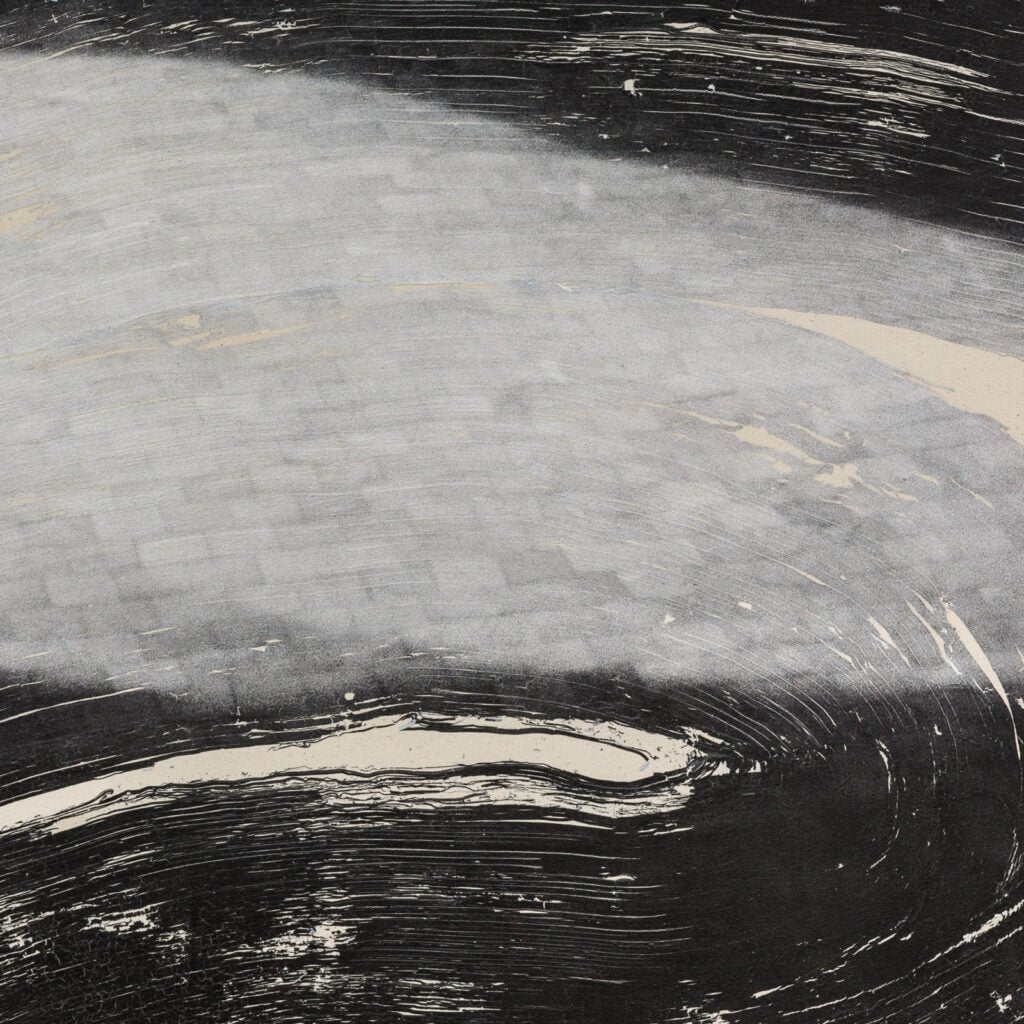
Artists are united by a shared investigation into memory, control, identity, and vulnerability in contemporary society. Alexander Adamau examines systems of protection and discipline, revealing how care and safety devices can become mechanisms of surveillance, dependency, and psychological constraint. Ant Łakomsk and Bartosz Kowal approach the image as an unstable space: Łakomsk through fragmented landscapes and solitary figures suspended between memory and urban alienation; Kowal through a quasi-cinematographic analysis that dissolves identity into dreamlike, dissociated states. Hanna Antonsson merges organic and technological matter, exploring transformation, hybridity, and the cyclical tension between life and artificial intervention. Linda Lach addresses isolation, care, and bodily exhaustion, translating personal and historical memory into abstract, layered forms. Polina Sokolova confronts power, surveillance, and the anxiety of being watched, while Tatjana Danneberg treats memory as a fragmented archive where images emerge as distorted reconstructions of the past.
