



Stefano De Paolis – Ritratti ideali
Comunicato stampa
Per i ritratti ideali di Stefano De Paolis
Filippo Bosco
Rileggere una pagina per tornare a un pensiero; ascoltare musica e indugiare in un sentimento; fumare una sigaretta alla finestra; o, curvo sul foglio, lasciarsi assorbire dai gesti del disegno. Questi ritratti quietissimi di De Paolis sembrano rileggere il genere secondo un etimo alternativo (“re-trahere”). Ri-trarsi è qui una sottrazione, fare un passo indietro guardando l’immagine, allontanarla dall’evidenza e dalla necessità di un incontro. Non “trarre dal naturale” ma esplorare una distanza, tessere un filtro, o concedersi un tempo troppo lungo fino alla sovraesposizione.
Il paradosso del ritratto si risolveva per Georg Simmel in chiave sociologica. “Nella realtà quotidiana, la pura apparenza di una persona non è affatto autoevidente. Tra i nostri rapporti quotidiani, inclusi quelli basati sui soli segni dell’apparenza esteriore, la dimensione psichica ha una tale sovrana importanza che la nostra percezione si sposta immediatamente oltre i tratti esterni verso gli elementi psichici di cui questi tratti sono o sembrano il simbolo”. Insomma, “i movimenti e le azioni di una persona, la sua provenienza sociale, e le generali contingenze della vita, per non dire delle nostre instabili prospettive e interessi in quanto spettatori – tutte queste cose inibiscono un’immagine chiara e inequivocabile”. Il talento del ritrattista sarebbe dunque di rimanere su un piano puramente visivo e formale e insieme evocare – come fa un simbolo – il complesso esistenziale di una persona. “Le apparenze devono rendere un’anima, e tuttavia un’anima deve rendere le apparenze!” Scritte nel 1918, queste parole accompagnavano la vicenda del ritratto dopo le avanguardie, una volta divenuto astrazione in forma di segni, dal miscuglio confuso di sensi e sentimenti, dell’anima, qualcosa di muto, metafisico, inaccessibile. Di qui le numerose strategie di inversione e scarto tra immagine e identità, dalle deformazioni dell’espressionismo agli assemblaggi dadaisti, dai manichini e dalle statue di De Chirico alle personalità fittizie di Casorati (e forse giù giù fino ai primi piani prostetici di Diego Marcon). Ma già un secolo prima Antonio Canova scolpiva “volti ideali”, che qualche anno fa sono stati raccolti in una bella mostra alla Galleria d’Arte Moderna di Milano. In quei busti, quasi tutti femminili e ammiratissimi dai contemporanei, la levigatura (la sottrazione del marmo) coincide con l’elisione degli accidenti fisiognomici da ogni superficie, linea e simmetria, un lavoro che addensa fascino e magnetismo su queste figure impossibili.
I ritratti ideali di De Paolis riannodano questi problemi, sebbene non puntino a una regola o alla selezione di forme armoniche e assolute. Ideali erano già negli anni passati i suoi armadi, stufe, orologi e tazzine dal design candido e geometrizzante. Oggetti unici e pretestuosi, ma anche generici, lasciati galleggiare in una curiosa foschia, la stessa che nei nuovi ritratti sfalda la “pregnanza, esattezza, necessità” evocate da Simmel. Le figure si ritraggono, indietreggiano, come le immagini che dall’Idea platonica discendevano deteriorandosi, e perdono risoluzione.
Ma è proprio la flebile apparenza dei disegni ad attirare chi osserva a poche spanne dal foglio, come per diradare un delicato particolato atmosferico che a distanza li rende illeggibili. A ben vedere le figure sono una, sempre la stessa, Stefano, che ha smesso i costumi estrosi (peraltro già vaghi nelle opere precedenti) del Pilota Intergalattico X e che ora ritrae le sue abitudini. Sono autoritratti soltanto in senso operativo: alcuni autoscatti servono come moodboard e messa a punto delle pose; poi come traccia riportata per l’esecuzione, che viene presto sommersa dalla semplificazione dei dettagli e dal lungo lavoro unificante di tratteggio. La figura del sé è paradossalmente la più generica, la meno idiosincratica: De Paolis non cerca l’autobiografia o una riflessione sull’autografia (pur confrontandosi con i travestimenti fotografici di Salvo o i riflessi di Giulio Paolini). E pure, a dirla tutta, una dolce tristezza rimane come un residuo di sé nelle posture e nelle intenzioni.
Il disegno di De Paolis pareggia la pittura se misurato sul terreno delle risorse e delle possibilità, aperte da una materia preziosa e versatile, la grafite, a cui si chiede di coprire tutta la superficie e modulare toni con esattezza inesorabile. L’artista, un “giovane che guarda Lorenzo Lotto”, ma anche Correggio e Giorgione, si cimenta oggi specialmente nel problema luminoso, nella resa dell’aria che gira intorno alle teste e si inoltra sotto gomiti e polsi, persino fluttua tra le dita, un’ambiance che non si accorcia pur nei limiti ostici di un chiaroscuro senza scuri. C’è da perdersi attraverso le campiture che passano e ripassano sul foglio, che si legano alla grana della carta, sempre controllata tanto quanto i ritmi della mina della matita. È spesso in corrispondenza delle mani che si accentua, ma sporadicamente, la tornitura plastica, così che i gesti già di abbandono o di sostegno sono ancora più immobili. Nel disegno più recente la ricerca luminosa si scopre nella sfida del controluce, il problema di stagliare una silhouette entro una finestra sul bianco del foglio, e al di qua far baluginare la sigaretta.
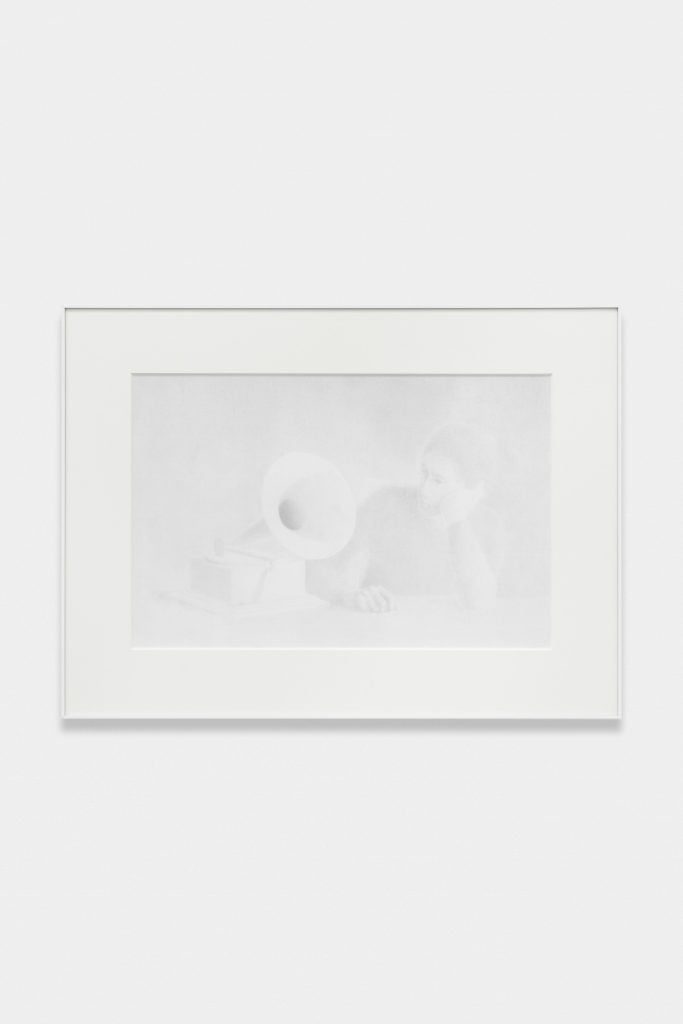
In un disegno grande e orizzontale un ragazzo assorto, in una posa manetiana, sembra ascoltare i suoi pensieri più che il suono del grammofono che gli sta accanto, immobile anch’esso, forse un modellino di plastica. La composizione è risucchiata così verso il disco netto dell’imbuto dello strumento, sulla cui curva perfetta si riordina tutta la scala tonale di De Paolis, dal bianco ai tratti fitti di una mina B.
L’ensemble di abitudini silenziose è (inevitabilmente?) suggellato da una mise en abîme, un ritratto del disegnare stesso che ha un che di anacronistico, se la sua semplicità ricorda le prime immagini che ci siano pervenute delle pratiche su carta in età moderna, come alcuni fogli del fiorentino Maso Finiguerra e bottega di metà quattrocento. Il disegnatore vi compare teso e concentrato mentre con uno stilo verga un foglio, il gomito a compasso, e porta l’occhio a pochi centimetri, premendo il foglio con la mano sinistra come per bloccarlo. Tutta la figura si schiaccia sul margine inferiore del formato verticale. Un gesto forzato e quasi goffo, un movimento innaturale del corpo, che detta un disegno senza istinto, che allontana tocchi o cenni, che trattiene, e si ri-trae.
ENG
On Stefano De Paolis’s ritratti ideali
Filippo Bosco
Going back to a book to revisit a thought; listening to music and lingering on a feeling; smoking a cigarette by the window; or, bent over the sheet, letting oneself be absorbed by the gestures of drawing. De Paolis’ utterly still portraits seem to reinterpret the genre according to an alternative etymology of the Italian ritratto - ‘re-trahere’: to draw back, to withdraw. A subtraction, a step back before the image, distancing it from the self-evidence and necessity of encounter. Not “drawing from life” but exploring a distance, weaving a filter, or allowing oneself too long a time, all the way to overexposure.
For Georg Simmel, the paradox of the portrait could be expressed in sociological terms. “[…] in ordinary reality, a person’s pure surface appearance is by no means self-evident. Among our ordinary interrelationships, including even those proceeding solely from people’s outward marks of appearance, psychic dimensions have such sovereign importance that our perceptions immediately move beyond exterior features toward psychic elements whose symbol these features are or appear to be”. In short, “a person’s movements and actions, social background, and general contingencies of life, not to mention our own shifting perspectives and interests as spectators – all these things inhibit a clear and unambiguous picture of appearances”. The portraitist’s talent would thus lie in remaining on a purely visual and formal level whilst at the same time evoking – as a symbol does – the existential complexity of a person. “Appearances must yield a soul, and yet a soul must yield appearances!” Written in 1918, these words accompanied portraiture along the post-avant-garde era, once it had become abstraction in the form of signs, out of the confused mixture of senses and feelings, of the soul, something mute, metaphysical, inaccessible. Hence the numerous strategies of inversion and divergence between image and identity, from the distortions of Expressionism to Dadaist assemblages, from De Chirico’s mannequins and statues to Casorati’s fictional personalities (and perhaps all the way down to Diego Marcon’s prosthetic close-ups). But a century earlier, Antonio Canova was already sculpting ‘ideal faces’, which were the subject of a beautiful exhibition at the Galleria d’Arte Moderna in Milan a few years ago. In those busts, almost all female and greatly admired by his contemporaries, the polishing (the removal of marble) coincides with the elimination of physiognomic features from every surface, line and symmetry, a process that imbues these impossible figures with charm and magnetism.
De Paolis’s ideal portraits revisit these issues, though they do not aim for regulatory, harmonious or absolute forms. He already used the adjective “ideal” in the past years for wardrobes, stoves, clocks and cups, with their pure and geometric design. Unique and capricious objects, yet also generic, left to float in a curious haze – the very same haze that, in the new portraits, erodes the “significance, precision, necessity” evoked by Simmel. The figures recede, draw back, like the images that descended from the Platonic Idea, deteriorating as they did so, and lose their definition.
But it is precisely the faint appearance of the drawings that draws the observer close to the sheet, as they try to dispel a delicate atmosphere that renders them illegible from a distance. On closer inspection, the figures are one and the same: Stefano, who has cast aside the whimsical costumes (already vague in his previous works) of the Pilota Intergalattico X and now portrays his own simple habits. They are self-portraits only in a practical sense: some selfies serve as mood boards and for arranging poses; then as an underdrawing for the execution, which is soon submerged by the simplification of details and the lengthy unifying work of hatching. The figure of the self is, paradoxically, the most generic, the least idiosyncratic: De Paolis does not seek autobiography or a reflection on autography (though he engages with Salvo’s photographic disguises or Giulio Paolini’s reflections). And yet, to be honest, a gentle sadness remains in the postures and intentions as a residue of the self.
De Paolis’s drawing stands on a par with painting when judged in terms of the resources and possibilities offered by a precious and versatile medium—graphite—which is called upon to cover the entire surface and modulate tones with unyielding precision. The artist, a ‘young man looking to Lorenzo Lotto’, but also to Correggio and Giorgione, now focuses particularly on the issue of light, on rendering the air that swirls around heads and slips beneath elbows and wrists, even floating between fingers—an ambiance that remains undiminished even within the challenging confines of a chiaroscuro of light-only tones. One can lose oneself in the washes that pass over and return to the paper, binding themselves to the paper’s grain, always as controlled as the rhythms of the pencil lead. It is often where the hands are that the plastic form is accentuated, though sporadically, so that gestures already of abandonment or support are rendered even more immobile. In the most recent drawing, the exploration of light is revealed in the challenge of backlighting, that is, the problem of silhouetting a figure within a window against the white of the paper, and letting the cigarette flicker on this side.
In a large, horizontal drawing, a pensive young man, in a Manet-like pose, seems to be listening to his own thoughts rather than the sound of the gramophone beside him, also motionless, perhaps a plastic model itself. The composition is thus drawn towards the smooth disc of the instrument’s funnel, upon whose perfect curve De Paolis’s entire tonal scale is reordered, from white to the dense strokes of a B-lead.
This ensemble of silent habits is (inevitably?) sealed by a mise en abîme, a portrait of the act of drawing itself that has a certain anachronistic quality, if its simplicity recalls the earliest images that have come down to us of drawing on paper in the modern era, such as certain sheets by the Florentine Maso Finiguerra and his workshop from the mid-fifteenth century. The draughtsman appears tense and focused as he traces a sheet with a stylus, his elbow acting as a compass, bringing his eye to within a few centimetres, pressing the sheet with his left hand as if to hold it in place. The entire figure is squeezed against the lower edge of the vertical format. A forced and almost clumsy gesture, an unnatural movement of the body, declaring a drawing devoid of instinct, shunning sketches or strokes, holding back, and with-drawing.
