



61. Biennale Arte – Padiglione Uzbekistan
Comunicato stampa
The Uzbekistan Art and Culture Development Foundation (ACDF) announces the Uzbekistan National Pavilion at the 61st International Art Exhibition – La Biennale di Venezia, featuring the exhibition The Aural Sea. Commissioned by ACDF Chairperson Gayane Umerova, the Pavilion turns to mythmaking and storytelling as ways of responding to environmental transformation – and of learning from the Aral Sea region of Karakalpakstan, Uzbekistan. Since the 1960s, the large-scale diversion of the region's rivers for agricultural irrigation has caused the Aral Sea to lose over 90% of its volume, turning one of the world's largest inland lakes into desert.
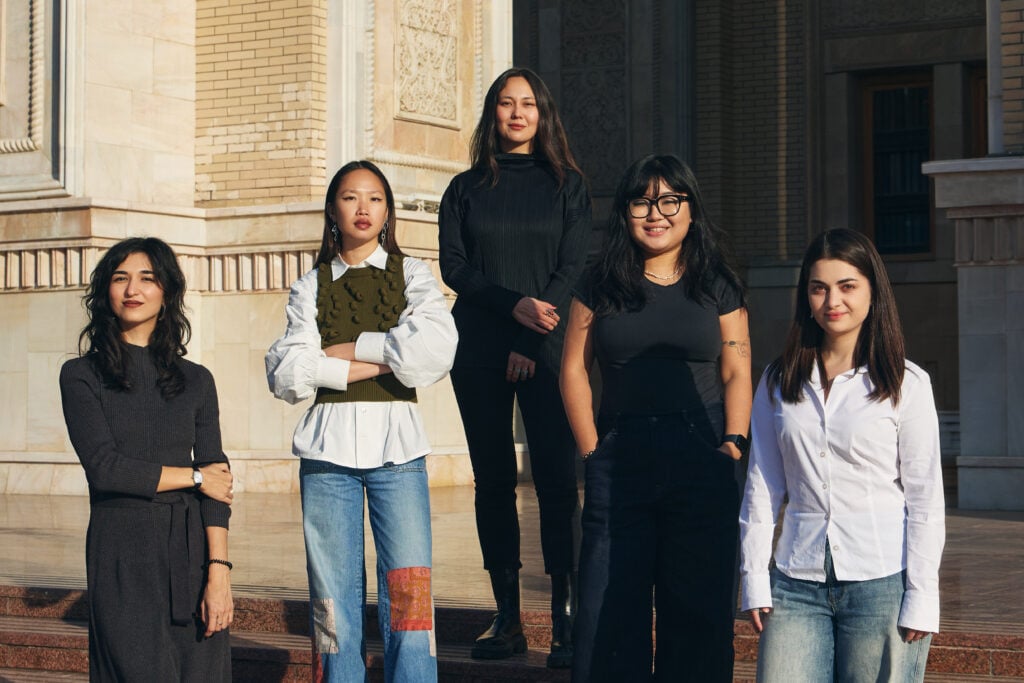
The Pavilion’s curatorial team, Sophie Mayuko Arni (b. 1995, Switzerland), Aziza Izamova (b. 1997, Uzbekistan), Kamila Mukhitdinova (b. 2003, Uzbekistan), Nico Sun (b. 1998, China), and Thái Hà (b. 1996, Vietnam), was formed through the Bukhara Biennial Curatorial School, an ACDF initiative commissioned by Gayane Umerova and led by the inaugural Bukhara Biennial Artistic Director Diana Campbell. Working collectively, they approach the Aral Sea through mythmaking and storytelling, treating imagination as a tool for thinking through environmental change.
Working across installation, interactive work, and painting, the pavilion artists Jahongir Bobokulov (b. 1996, Uzbekistan), Zi Kakhramonova (b. 2001, Uzbekistan), Aygul Sarsen (b. 2005, Karakalpakstan, Uzbekistan), Zulfiya Spowart (b. 1991, Uzbekistan), Xin Liu (b. 1991, China), A.A.Murakami (b. 1983, United Kingdom and b. 1984, Japan), and Nguyen Phuong Linh (b. 1985, Vietnam) bring practices that range from scientific modelling to folkloric imagination, from monumental textile to intimate craft. Together, the artists approach the Aral not as a problem to be solved, but as a site of knowledge.
The Aral basin has long been a crossroads. Situated on the northern branch of the Silk Road, the region's archaeological record reveals layers of civilisation shaped by the dynamics of water. When Marco Polo travelled through Central Asia in the thirteenth century, the Aral Sea does not appear in his account, an absence that resonates with a landscape whose shorelines have shifted over centuries. Here, the presence and absence of water is not only a modern condition but a long temporal structure that continues to shape how communities live, remember, and imagine. Fishermen have told stories of glimpsing ruined cities on the lakebed; such moments became the seeds of new legends, binding past and future in a single image.
The Pavilion takes inspiration from Karakalpak author Allayar Darmenov, who began writing the Aral Sea back to life in 2015, when he was 18 years old. In his fiction, swordfish race through replenished waters and remember the desert years. Following Darmenov, the Pavilion proposes imagination as a form of agency: mythmaking and storytelling not as escape, but as tools for navigating loss and holding open space for what might yet be possible.
Responding to the 61st Biennale's theme In Minor Keys, the Pavilion’s title, The Aural Sea, signals the exhibition's method: listening. The Pavilion asks what it means to hear a landscape that has been dramatically transformed, and what we might learn from attending to voices that have lived with that transformation for generations.
The scenography and architecture of the Pavilion is being developed by a select group of architecture students and young architects from some of Uzbekistan’s leading architecture institutes, including Ajou University in Tashkent, and the Tashkent Institute of Architecture and Civil Engineering. Shokhrukhbek Dilmurodov, Khayitali Gofurov, Makhil Mavlyanova, and Shakhruza Uktamova are working with advised by GRACE (Ekaterina Golovatyuk, Giacomo Cantoni, Ksenia Bisti).
This Pavilion, Uzbekistan’s third participation in the International Art Exhibition – La Biennale di Venezia, draws on the Foundation's sustained engagement with the region through the Aral Culture Summit – a transdisciplinary platform convening artists, scientists, policymakers to bridge scientific research with local knowledge, support community-led initiatives, and seed long-term cultural infrastructure in the region – and the newly launched Aral School, a design programme building capacity and developing prototypes for the region's future.
Gayane Umerova, Chairperson of the Uzbekistan Art and Culture Development Foundation, says: “The Aural Sea reflects ACDF’s long-term commitment to the Aral Sea region and to building culture through knowledge and sustained engagement. From the Bukhara Biennial Curatorial School to the interdisciplinary Aral School in Karakalpakstan, we invest in people and ideas that address cultural and ecological futures. By bringing together diverse voices, this Pavilion creates a space for exchange between disciplines, between generations, and between different ways of knowing what it means to live with ecological change.”
The curatorial team says: “In The Aural Sea, mythmaking and storytelling become ways of coping with environmental change and imagining futures beyond what is immediately visible. The exhibition understands imagination not as escape, but as agency, one that allows artists to work through transformation and possibility. Our curatorial thinking grew out of shared learning and conversation shaped by the Bukhara Biennial Curatorial School, supported by the Uzbekistan Art and Culture Development Foundation.”
Alongside the Uzbekistan National Pavilion, ACDF will present Instruments of the Mind, a landmark solo exhibition by Vyacheslav Akhunov, as an official collateral project of the 61st International Art Exhibition – La Biennale di Venezia at Palazzo Franchetti, presented by the Centre for Contemporary Arts Tashkent (CCA).
The Aural Sea, The Uzbekistan Pavilion at the 61st International Art Exhibition – La Biennale di Venezia, commissioned by Gayane Umerova, Chairperson of the Uzbekistan Art and Culture Development Foundation, 9 May – 22 November 2026
acdf.uz
