
The Invisible Chord. Hans Hartung and Music
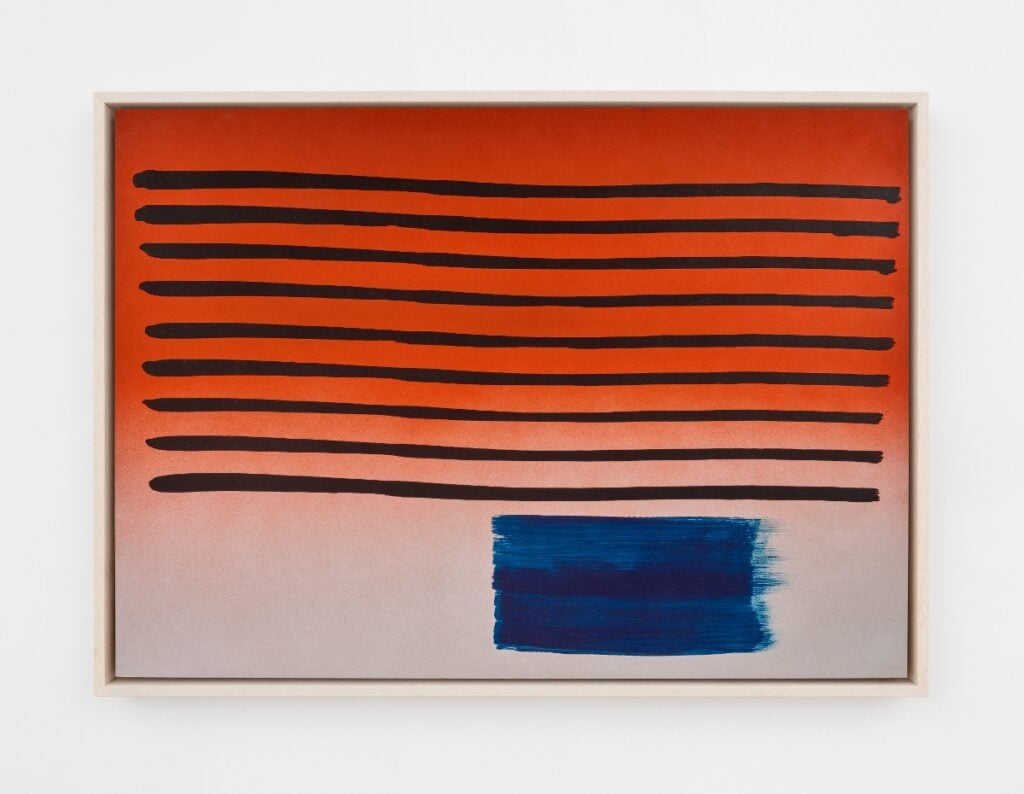
Riunendo quasi ottanta tra dipinti, documenti e utensili, la mostra restituisce al sonoro un posto di rilievo nell’universo plastico ed esistenziale dell’artista. Da Bach ai Pink Floyd, passando per Lili Boulanger, si ricostituisce un paesaggio di energie, gestualità e risonanze che attraversano l’intera creazione dell’artista.
Comunicato stampa
Bringing together nearly eighty paintings, documents, and working tools, the exhibition explores the central role of sound in the artist’s plastic and existential universe. From Bach to Pink Floyd, including composers such as Lili Boulanger, a landscape of energies, gestures, and resonances runs throughout his entire body of work.
A gifted dancer and pianist in his youth, Hans Hartung was obsessively devoted to music – a true melomaniac, bordering on pathology. He abhorred silence. In a 1948 letter, Pierre Soulages recounts: “His radio is always on – when he comes to see me, he cannot resist playing his favorite records.” He adds: “Even moments of rest, and especially of work, were almost unbearable for him without music.” Hartung’s paintings are thus suffused with a sonic climate of rhythms, harmonies, and vocal or instrumental outbursts. Though silent, his work secretes melodic flows within its very fibers, emanating from the composers he revered.
Who were they? First and foremost, the great figures of the Baroque: Bach, Handel, Vivaldi. The Goldberg Variations, the Sarabande, and The Four Seasons filled his studio as he painted, whether with a brush, a lithographic roller, or industrial spray guns. He also listened attentively to modern composers such as Lili Boulanger, Pierre Boulez, and even Philip Glass.
Hartung was never a theorist of the relationships between sound, color, and form. Unlike artists such as Kandinsky, Schönberg, and their followers, who pursued synesthetic or intellectual explorations, his relationship to music was far more direct: physical, intuitive, and pragmatic. In short: without music, no pictorial creation, and without creation, no reason to exist, since for the artist, “the joy of living is inseparable from the joy of painting.”
This exhibition in Venice – where Hartung achieved one of his greatest triumphs – presents works from the 1920s to the end of his life, each bearing the trace of his gesture and action. They reflect his physicality, personal history, and place within collective history: as a World War II amputee and a German resister to Nazism. They also testify to what he was musically: a tireless listener whose canvases crystallized fugues, symphonies, operas, and sonatas.
The exhibition traces the origins of this passion through early works and exclusive archives. It explores analogies between abstract pictorial processes and musical composition or orchestration, identifying affinities with figures such as Brahms and Stockhausen. It also delves into more speculative approaches, evoking, for instance, the cosmo-psychedelic dimension of the 1960s and its echoes in the contemporary rock scene, as well as the recurring temptation of silence.
Finally, the exhibition invites visitors to discover several of Hartung’s studio tools, archival documents, and films, immersing them in his sonic universe. A specially commissioned video, presented in Riva Botta, features short interviews with composers, performers, and choreographers reflecting on Hartung’s work.
