
61. Biennale Arte – Liberation Space: Fortress/Nest
Comunicato stampa
Commissioned by ARKO (Arts Council Korea), the Korean Pavilion is thrilled to announce the concept and details of its presentation at the 61st International Art Exhibition of La Biennale di Venezia. Liberation Space: Fortress/Nest is helmed by curator Binna Choi, who invited Seoul-based Goen Choi and New York-based Hyeree Ro—both of whose unique and diverging sculptural practices engage the interplay between abstraction and figuration—to transform the Pavilion into a living monument to the idea of a “Liberation Space.” The term “Liberation Space” references the three-year period (1945-1948) of new nation-building that directly followed Korea’s liberation from Japanese colonial rule. Liberation Space: Fortress/Nest draws on this pivotal turning point for the country and situates it within a contemporary geopolitical context. The project also integrates an inaugural Fellowship of artistic, cultural, social, and political practitioners working alongside the artists. Comprised of writer and singer Lang Lee, Nobel Prize-winning novelist Han Kang, photographer Yezoi Hwang, activist-farmer Huju Kim, and artist Chrstian Nyampeta, these Fellows bring their diverse cultural expressions to bear on the central theme of South Korean nation-building, past, present, and future.
Liberation Space: Fortress/Nest acknowledges that there is no singular moment of liberation from colonial oppression, but rather a continuous process of conflict and renewal amidst the pursuit of conflicting aspirations for nation-building as an “unfinished project.” Inviting the global public to explore what “liberation” can mean today, the exhibition (aka “monument”) asks what kinds of nations liberation can create—a question underpinned by the events of winter 2024/5 in South Korea, wherein a sudden declaration of martial law by an incumbent president was swiftly countered by citizens and lawmakers alike, not to mention soldiers resisting mobilization orders.
The events following this declaration included huge weekly rallies that solidified a new culture of protest, counter-demonstrations from the far right in defense of the martial law decree, the president’s eventual impeachment, and the establishment of a new democratic administration to lead the country. Despite this apparent progress, however, seemingly irreconcilable differences do persist—a reality that shapes Choi’s curatorial argument for the continued existence and renewal of a “Liberation Space.” This sentiment extends to applications beyond the domestic framework of Korea, spanning much of contemporary international society. Amidst global analyses of national sovereignty and the rise of far-right politics worldwide, this exhibition seeks to emphasize the importance of reclaiming the “Liberation Space,” here and now.
Binna Choi, Curator, comments: “Rather than creating an exhibition within the Pavilion or forcing a counter-narrative to the idea of national representation, I chose to engage the structure as a whole, working with the significance of its form and position—established in 1995, a pivotal year for South Korea’s decolonization, and wedged between the pavilions of Japan, Russia, and Germany—to build a living, operational monument to “Liberation Space” writ large. The task is to envision how a nation—in this case, a divided one like Korea—might be reimagined and mobilized in the creation of new worlds.”
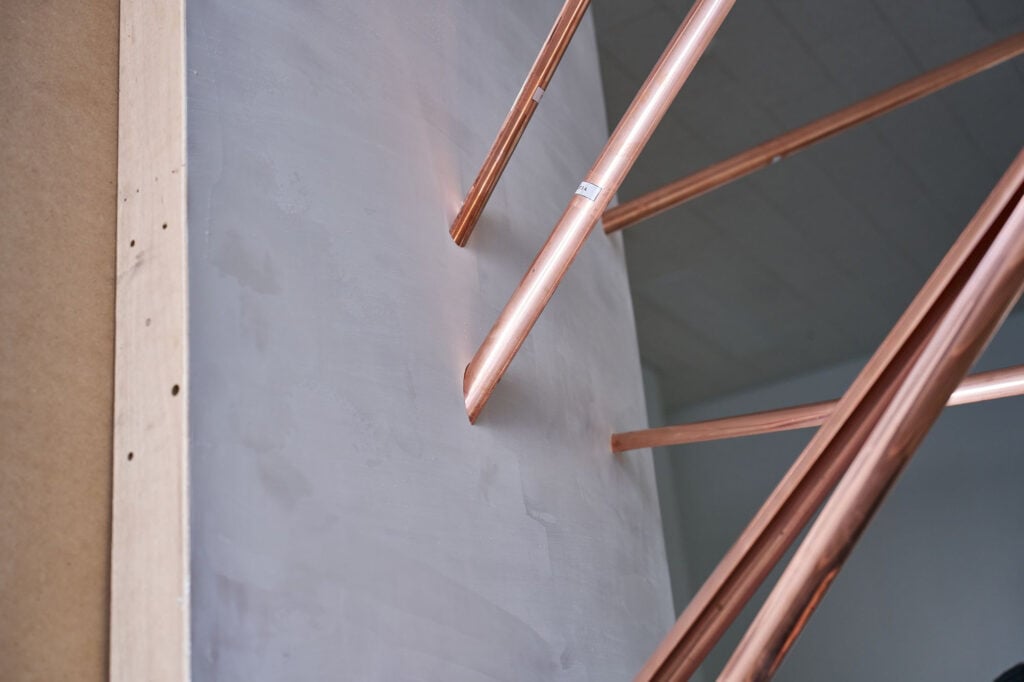
For Liberation Space: Fortress/Nest, each of the artists utilizes their respective sculptural practices to transform the Korean Pavilion into a living monument. Goen Choi’s Meridian builds on her decade-long practice of manipulating domestic infrastructural materials, including copper pipes, to create site-specific interventions. With an acupuncture-like precision, the work penetrates the Korean Pavilion building, traversing interior and exterior while evoking analogous linear forms such as needles, spears, branches, or beams of light. Focusing on the pavilion’s central cylindrical structure, the work features multiple pipes that pierce and rupture the building as a body even as it suggests the action of circulating and healing. By using industrial materials to craft defensive, sharp, and precise forms, Choi induces the idea of a “fortress”: a structure or body of defense that, paradoxically, allows for revelation, openings, and dynamic movement to unfold from within the Pavilion. This sculptural action also opens up the second floor space of the Korean Pavilion, which was closed soon after its opening and remained so for decades.
Goen Choi, Artist, says: “The Korean Pavilion is not a fixed symbol but a constellation of forces that continually shake, shift, and reorganize. In engaging the context around the space, I focused not on creating or adding something new, but on uncovering, reconsidering, and restoring what is already there. Working on this piece, I came to see the Pavilion’s relational dynamism as a structure that has, under constant tension with its surroundings, urgently and continuously reoriented itself—and it occurred to me that this might be the very thing that carries us into what comes next.”
Contrastingly, Hyeree Ro’s delicate, haptic approach creates a space of embrace—or, indeed, a “nest.” After encountering Choi’s audacious and sharp intervention into the structure of the pavilion, visitors enter a subtle, intimate space through Ro’s work. Liberation Space: Fortress/Nest marks a departure from Ro’s longstanding (anti-)narrative forms and recurring themes of family relations caught up in various sociopolitical and economic structures, widening the scope of her subject matter—following a period of mourning for her belated father—to include themes of new life, community and even nationhood. Ro’s work for the Korean Pavilion, titled Bearing, considers the “womb” as a sanctuary—or “temple”—for new life; by the same token, death here is the condition for life, thus enabling movement. Composed of roughly 4,000 organza circles—a material commonly used in Italy and eastern Asian contexts for ceremonial occasions—coated in wax and layered like fish scales or lotus leaves, Bearing builds a “pavilion within the pavilion,” one that resists enclosure to form a passageway for careful, guided movement through the space. This movement is then punctuated by a series of eight stations, each of which prompts an essential act of life: these include mourning, remembering, observing, living, waiting, planning, sharing and repairing. Here, the title Bearing holds truth to its equivocal meanings.
Hyeree Ro, Artist, adds: “‘To bear’ means to endure and support weight, to change direction, to bear fruit, and to give birth. As I reconsidered the time and space of holding, enduring, and supporting, the mechanical component known as a ‘bearing’ also came to mind—a device that restricts certain movements and reduces friction in order to enable a desired motion, the representative example being the ball bearing: its fixed outer ring, its moving inner ring, and the small steel balls that allow it to turn. A bearing is a device that moves not only the inner ring but also the larger structure around it. The fact that this device generates movement resonates with our understanding of ‘liberation space’ as a field of movement.”
Working alongside Choi and Ro, a Fellowship of artistic, political, and social practitioners expand and deepen the scope of the exhibition. The inaugural cohort of Fellows is centered around those whose practices address critical historical events of South Korea in the process of nation-building, including the 2024/5 demonstrations. Across multiple forms of artistic and cultural expression spanning lino prints, photography, sculpture, songs, and flags, the contributions of the Fellows will be integrated into Bearing, extending its many stories.
To experience the pavilion as a living monument to “Liberation Space” is to experience the ongoing, circular movement through “fortress” and “nest,” inside and outside, up and down, hard and soft, with stories not only found but also created by visitors as well as Fellows. This proposed action will be amplified by a Network of steadfast “liberation spaces” around the world. In addition, an unprecedented collaboration between the Korean Pavilion and Japan Pavilion—the Giardini’s only two Asian pavilions, whose shared history carries both light and shadow—will underscore this understanding of liberatory movement as ongoing practice, offering themselves as an exemplary case for the world.
Liberation Space: Fortress/Nest will be on view at the Korean Pavilion at the 61st International Art Exhibition of La Biennale di Venezia from May 9 to November 22, 2026.
Exhibition information
Liberation Space: Fortress/Nest
Commissioner: Arts Council Korea;
Curator: Binna Choi;
Exhibitors: Goen Choi, Hyeree Ro
Open to the public from May 9, 2026 to November 22, 2026
Located at Giardini Della Biennale, Sestiere Castello, 30122 Venice, Italy
Visitor information and tickets for La Biennale di Venezia can be found here.
About ARKO
ARKO (Arts Council Korea) is a national organization dedicated to supporting and promoting Korean arts and culture, managing key venues and initiatives like the ARKO Arts Center and the Korean Pavilion at the International Art Exhibition and the International Architecture Exhibition of La Biennale di Venezia.
About Binna Choi
Binna Choi brings two decades of experience working internationally while sustaining deep connections to her roots in the Korean cultural and socio-political landscape. She has been at the forefront of shaping new institutional models through her directorship of Casco Art Institute: Working for the Commons in Utrecht, the Netherlands. Her recent curatorial projects in the biennale context include the 2025 Hawai’i Triennial, titled ALOHA NÔ, and the 2022 Singapore Biennale, named Natasha. In the educational context, Choi has also worked with the Doosan Curator Workshop (2024-ongoing), Gwangju Biennale International Curator Course (2025), and Dutch Art Institute (2008-2022).
About Goen Choi
Goen Choi works primarily with hard metals often used in domestic infrastructures, creating site-specific sculptural interventions that extend from interiors to rooftops, balconies, and other exterior architectural spaces. Her practice integrates entire sites into a single organic context, traversing the boundaries between the inside and the outside. Recent projects include new commissioned works for the 2nd Frieze Seoul Artist Award (2024) and the 7th Changwon Sculpture Biennale (2024), Cornering, a solo exhibition at Amado Art Space (2022), and Vivid Cut at P21, Seoul (2021).
About Hyeree Ro
Hyeree Ro is an artist based in Brooklyn, New York and Seoul, primarily working with hand-crafted sculptural objects and structures, and multi-lingual fractured narrative-based performance. As a constant migrant passing through various immigrant statuses and encountering disparities in class and wealth, she interweaves her family history, places, language, body, movement, and stories into her practice. Recent projects include solo exhibitions August is the Cruelest at Doosan Gallery, Seoul (2025), Niro at Canal Projects, New York (2024), and Jinhee at Project Space SARUBIA. Seoul (2022). Ro also serves as an Assistant Arts Professor of Collaborative Arts at NYU Tisch School of the Arts.
