
Felix Kiessling – Etere
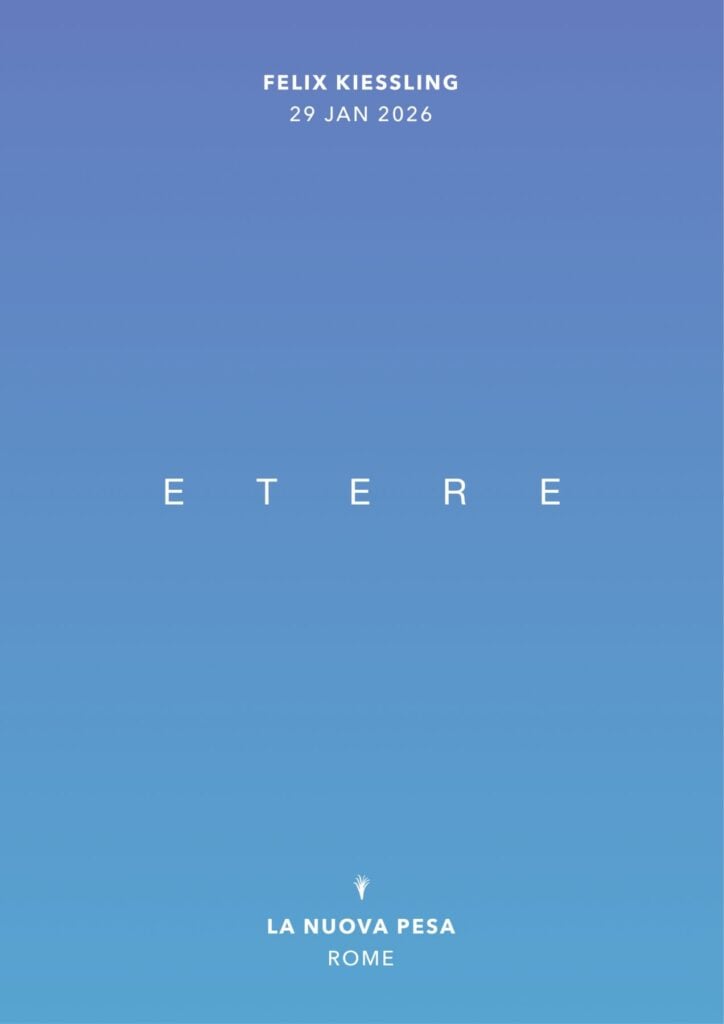
Mostra personale di Felix Kiessling “ETERE” alla Galleria La Nuova Pesa, con la collaborazione della Galleria Mario Iannelli.
Comunicato stampa
ETERE di Felix Kiessling è un viaggio nel tempo e nella materia, un tempo inteso come campionamento e interpretazione, e una materia che si manifesta nella dimensione della carica e dell’energia dell’atomo, nelle onde elettromagnetiche della luce e nella dimensione soggettiva e collettiva dell’esperienza temporale. Il percorso espositivo si muove all’interno di una realtà fluida, non oggettiva, che si offre al sistema cognitivo attraverso il fenomeno, dove percezione, spazio e tempo emergono come costruzioni condivise e in continua trasformazione.
La mostra propone esperienze corporee e sensoriali che traducono l’energia e la luce in forme percepibili.
La luce stroboscopica attraversa il corpo dello spettatore, coinvolgendolo direttamente e richiamando la dinamica delle high-energy particles. In questo contesto si colloca The Ionogram Butterfly, un punto di luce concentrato e brillante, installato all’altezza degli occhi, che rende visibili in tempo reale i risultati della ricerca Ionosond di SAASST, dialogando con l’ionosfera e ascoltandone i segnali, dove particelle ad alta energia originate da esplosioni sulla superficie solare interagiscono con l’atmosfera terrestre. L’opera, installazione permanente al Planetario di Sharjah / SAASST negli Emirati Arabi Uniti, introduce l’esperienza immersiva della mostra, stabilendo un legame diretto tra il corpo, la luce e l’energia planetaria.
La vibrazione diventa materia solida nei blocchi di alluminio che condensano una sostanza impalpabile in forme pittoriche, trasformando l’energia in oggetti tangibili. Come sottolinea Kiessling: «L’intera mostra non riguarda una visione gerarchica singola, ma collettiva». Questo principio è evidente nella genesi cromatica dei blocchi, determinata dalla mescolanza di campionamenti effettuati in luoghi differenti alla stessa ora: Zenith, il punto di massima intensità luminosa; Just Before, il momento di minima luce; e Atacama, basato sull’occhio interiore dell’artista e sulla memoria di un cielo particolarmente intenso osservato nel deserto di Atacama.
L’esplorazione dell’etere si completa con Abtastung, che indaga la percezione fenomenica del cielo e dello spazio planetario attraverso il principio della diffusione di Rayleigh. La luce blu, con lunghezza d’onda più corta, viene diffusa più intensamente dalle molecole dell’aria, mentre le frequenze più lunghe emergono nei colori rossi di albe e tramonti. Abtastung (“Scansione”) accelera il tempo e la diffusione di Rayleigh muovendosi a spirale intorno alla Terra, raccogliendo oltre 20.000 fotogrammi della luce del cielo. Attraverso il toccare — fisico e cognitivo — l’opera suggerisce come diamo senso alla realtà e come costruiamo un’interpretazione soggettiva del tempo. Il cielo non è più un corpo celeste distante, ma una presenza luminosa che attraversa lo spazio espositivo, un’emanazione che rimanda all’idea di etere come materia sottile e pura esperienza della luce.
Insieme, le esperienze della mostra trasformano la galleria in un campo percettivo unitario, dove la distinzione tra osservatore, opera e ambiente si dissolve. La luce non è solo un elemento estetico, ma un fenomeno capace di modificare la percezione del tempo, dello spazio, del corpo e dell’ambiente circostante.
Diverse tradizioni, dalla fenomenologia di Merleau-Ponty al movimento Light and Space di Irwin, dagli Skyspace di Turrell a The Weather Project di Eliasson, fino alle teorie enattive di Noë e Varela, hanno descritto la percezione come un campo condiviso. Con la sua pratica, Kiessling si inserisce in questo percorso, introducendo la tecnologia come componente sempre più attiva dell’esperienza e utilizzando concetti scientifici per riflettere sul rapporto tra l’essere umano e il mondo naturale.
“Abtastung” evolve la serie dei dischi luminosi Coloured Suns, nata dall’opera Anti-Sonne, e si inserisce in una ricerca che attraversa lo spazio (Earth Piercing), il tempo (Zeitzeichnung – Time Drawing) e fenomeni naturali tangibili, come i fulmini (Schmetterling), o intangibili, come le frequenze di Schumann (Sound of Earth), resi percepibili grazie a tecnologie satellitari in tempo reale. La particolarità di Abtastung risiede nel non utilizzare dati in tempo reale, ma nel basarsi su campionamenti già realizzati.
Parallelamente, Kiessling dialoga con lo spazio della galleria, inteso non solo come supporto architettonico, ma come soggetto attivo, portatore di tracce storiche e significati stratificati. L’immanenza della percezione e dell’evento dello “spazio planetario” si confronta con l’illusionismo degli antichi soffitti affrescati e con la mostra realizzata da Alberto Garutti alla Galleria La Nuova Pesa trent’anni fa, nel 1996, dal titolo Paesaggio domestico. In questa occasione è nuovamente esposta l’opera Specchio forato, grande superficie specchiante con fori che delineano il profilo di oggetti d’arredo riflessi nella stanza del soggiorno dell’artista. L’installazione, composta da due specchi che si fronteggiavano all’infinito, instaura un parallelo virtuale con l’opera di Kiessling “The Ionogram Butterfly” esposta nello stesso spazio.
Accanto a queste stratificazioni storiche e percettive, la mostra introduce un immaginario radicato nella dimensione simbolica del blu, inteso come soglia e promessa di spazio e possibilità. È all’interno di questa simbologia del blu che Abtastung accoglie tutti gli altri colori dello spettro, non come elementi separati, ma come stati e densità che emergono da un unico campo percettivo. In Abtastung, il campo condiviso è composto dagli stessi elementi che formano il cielo evocato dall’opera — aria, acqua, fuoco, terra ed etere, inteso come medium che li contiene e li rende percepibili come esperienza luminosa.
ETERE by Felix Kiessling is a journey through time and matter, where time is understood as sampling and interpretation, and matter manifests in the charge and energy of the atom, in the electromagnetic waves of light, and in the subjective and collective dimensions of temporal experience. The exhibition unfolds within a fluid, non-objective reality, offered to the cognitive system through phenomena, where perception, space, and time emerge as shared and constantly evolving constructions.
The exhibition offers bodily and sensory experiences that translate energy and light into perceptible forms. Stroboscopic light passes through the viewer’s body, engaging them directly and evoking the dynamics of high-energy particles. In this context is The Ionogram Butterfly, a concentrated, bright point of light installed at eye level, which visualizes in real time the results of SAASST’s Ionosond research, “dialoguing” with the ionosphere and listening to its signals, where high-energy particles from solar surface explosions interact with the Earth’s atmosphere. The work, a permanent installation at the Planetarium of Sharjah / SAASST Sharjah, United Arab Emirates, introduces the immersive experience of the exhibition, establishing a direct connection between the body, light, and planetary energy.
Vibration becomes solid matter in the aluminum blocks that condense an intangible substance into pictorial forms, transforming energy into tangible objects. As Kiessling emphasizes: “The entire exhibition is not about a single hierarchical vision, but a collective one.” This principle is evident in the chromatic genesis of the blocks, determined by the mixture of samplings taken in different locations at the same hour: Zenith, the point of maximum light intensity; Just Before, the moment of minimal light; and Atacama, based entirely on the artist’s inner eye and the memory of an especially intense sky observed in the Atacama Desert.
The exploration of ether culminates with Abtastung, which investigates the phenomenal perception of the sky and planetary space through the principle of Rayleigh scattering. Blue light, with a shorter wavelength, is scattered more intensely by air molecules, while longer wavelengths appear in the red colors of sunrises and sunsets. Abtastung (“Scanning”) accelerates time and Rayleigh scattering by spiraling around the Earth, capturing over 20,000 frames of sky light. Through physical and cognitive touch, the work suggests how we make sense of reality and construct a subjective interpretation of time. The sky is no longer a distant celestial body, but a luminous presence that permeates the exhibition space: an emanation that evokes the idea of ether as subtle matter and pure light experience.
Together, the exhibition’s experiences transform the gallery into a unified perceptual field, where the distinction between observer, artwork, and environment dissolves. Light is not only an aesthetic element but a phenomenon capable of altering the perception of time, space, the body, and the surrounding environment.
Various traditions—from Merleau-Ponty’s phenomenology to Irwin’s Light and Space movement, from Turrell’s Skyspaces to Eliasson’s The Weather Project, and the enactive theories of Noë and Varela—have described perception as a shared field. Kiessling’s practice is part of this continuum, introducing technology as an increasingly active component of the experience and using scientific concepts to reflect on the relationship between humans and the natural world.
Abtastung evolves from the series of luminous discs Coloured Suns, born from the work Anti-Sonne, and is part of a research path that spans space (Earth Piercing), time (Zeitzeichnung – Time Drawing), and tangible natural phenomena, such as lightning (Schmetterling), or intangible phenomena, like Schumann resonances (Sound of Earth), made perceptible through real-time satellite technologies. Abtastung’s peculiarity lies in not using real-time data, but relying on previously collected samplings, emphasizing the interpretative nature of time.
At the same time, Kiessling engages with the gallery space not only as architectural support but as an active subject carrying historical traces and layered meanings. The immediacy of perception and the event of “planetary space” confront the illusionism of ancient frescoed ceilings and the exhibition realized by Alberto Garutti at La Nuova Pesa Gallery thirty years ago, in 1996, titled Paesaggio domestico. On this occasion, Specchio forato is again on display, a large mirrored surface perforated to outline the profiles of furniture reflected in the artist’s living room. The installation, composed of two mirrors facing each other infinitely, establishes a virtual parallel with Kiessling’s The Ionogram Butterfly” exhibited in the same space.
Alongside these historical and perceptual layers, the exhibition introduces an imaginary rooted in the symbolic dimension of blue, understood as a threshold and promise of space and possibility. It is within this symbolism of blue that Abtastung integrates all the other colors of the spectrum, not as separate elements but as states and densities emerging from a single perceptual field. In Abtastung, the shared field is composed of the same elements that form the sky evoked by the work—air, water, fire, earth, and ether, understood as a medium that contains them and makes them perceptible as a luminous experience.
