
Alice Bucknell – I Clipped Horizon
Mostra personale.
Comunicato stampa
In In Free Fall (2011), Hito Steyerl suggests that we have lost horizontal perspective along with any shared ground. We’re living inside a collapse. No drama—just free fall. Here, falling does not necessarily mean falling apart but falling into place. Into a place with many more horizons, perhaps.
Alice Bucknell’s work follows the same logic, testing multiple perspectives—including the most uncomfortable ones—to keep the future open rather than having a single prediction.
Moving through Bucknell’s work feels like entering a conspiratorial Reddit thread, where CTO Seth is selling you sunsets to cool the Earth, and Elon’s twin—Jason—trained on Donna Haraway’s theories and SpaceX press releases, promises high-quality artistic events on Mars. Pure chemistry and capital.
Bucknell’s solo exhibition title, Clipped Horizon, borrows from video game terminology, where “clipping” means a glitch in which collision logic breaks—bodies pass through walls, NPCs show up partially embedded—but the system keeps running. Welcome to the cosmic bug.
Similar to conspiracy forums, spending enough time in Bucknell’s simulations, you follow a dopamine-driven arc—from confusion to recognition—seeing meaningful connections in random data. Except the data here is not random at all: from interviews with space lawyers, NASA astronomers, drone pilots, to 3D scans of the city, merging archival images of the LA river with existing proposals for its redevelopment.
The exhibition brings together three works by Alice Bucknell. The Martian Word for World (2022), a three-channel video that builds on Ursula K. Le Guin’s short story The Word for World Is Forest and Kim Stanley Robinson’s Mars Trilogy propose three very different futures for the Red Planet, alongside Bucknell’s research on interplanetary law. Spoiler—human settlement is not the necessary default.
In The Alluvials (2023), a nonlinear narrative about Los Angeles told by wildfire, the Los Angeles River, and the city’s celebrity mountain lion P-22 explores the doomed love affair the city has with water. Here, Bucknell works with speculative redevelopment plans and archival documents blending history and future to envision a reality-adjacent present. Navigating a brightly lit space of heat-treated metallic sculptures—among them an alligator, a space satellite, and a cowboy boot, melting as if left out too long in the sun—you enter the control room. Here, a dilettante documentarian enthusiastically briefs you on the dark side of solar geoengineering.
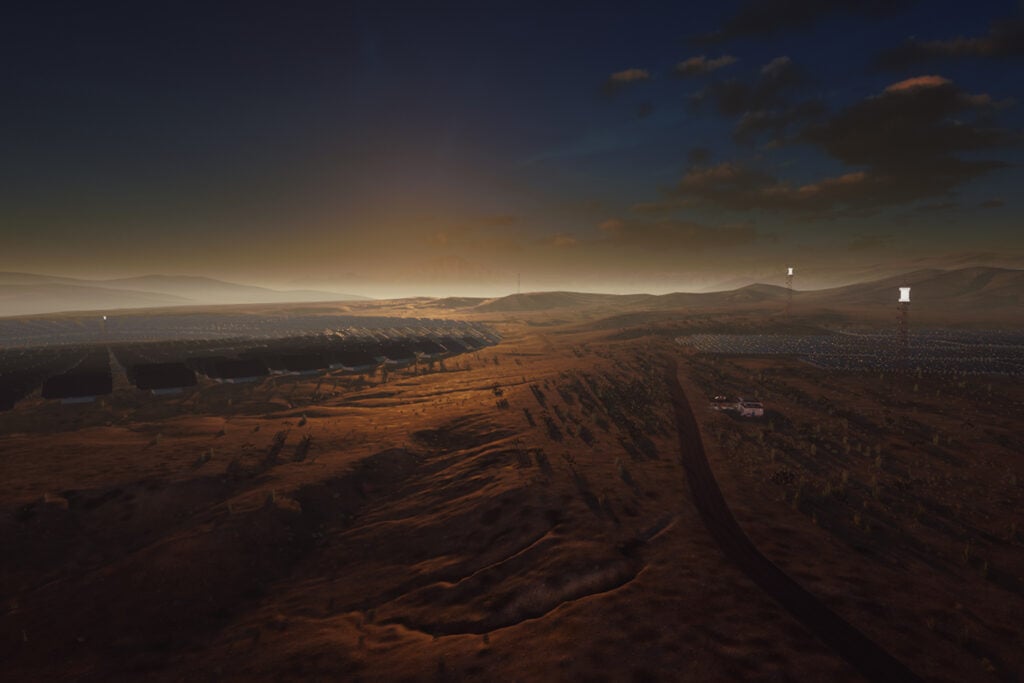
Somehow, in most games, the sun is just a decorative background asset. In Staring at the Sun (2024–25), the central piece of the exhibition, it is an agent and an object at the same time: a sci-fi documentary based on Bucknell’s interviews with scientists, engineers, and startup CEOs actively shaping, modeling, or testing how the sun, atmosphere, and climate might be altered. Staring at the sun is stupid and it hurts, but the urge to reckon the unknown and the unknowable keeps winning.
Narratives used to gain power by collapsing uncertainty. In a present characterized by narrative collapse, Bucknell’s work functions like a trap door. Clipping the horizon, we fall sideways into a world that offers totalized feeling rather than totalized knowledge.
Text by Alice Scope
