

Carsten Nicolai – Atlas Borealis
Mostra personale.
Comunicato stampa
Pinksummer: Recentemente hai detto che stai cercando di unire due personalità in una sola, di portare tutto a stare insieme.
Ci hai fatto pensare al paradosso quantistico degli stati sovrapposti, del gatto nel contempo vivo e morto di Schrödinger.
Di fatto abbiamo sempre pensato alle identità di Carsten Nicolai e Alva Noto come a una sovrapposizione di stati probabili. D’altra parte sembra che la prima particella della materia sia sorta dal vuoto spontaneo grazie a un’energia che vibra: in alcune civiltà lo chiamano Verbo, in altre “le vie dei canti”, e se estendessimo la ricerca nel tempo oltre che nello spazio arriveremmo sino alla Torre di Babele. Si dice che in realtà ciò che giudichiamo solido è un’illusione, e che l’universo dovrebbe essere inteso come un conglomerato di energia essenziale che vibra a velocità diverse—o meglio, a diverse frequenze.
L’illusione solida e essenzialissima di Carsten Nicolai non sorge dagli ambienti, che noi amiamo definire “paesaggi cimatici”, di Alva Noto?
Carsten Nicolai: Non sto necessariamente cercando di fondere le mie due personalità in una sola. Forse si tratta più della percezione del mondo esterno, perché, come sappiamo, esiste ancora una netta divisione tra il mondo della musica e quello delle arti visive. A volte questi mondi collidono—o almeno per quanto mi riguarda, collidono spesso, e interagiscono—ma nella percezione della stampa, della ricerca e anche della storia dell’arte, l’idea che questi due mondi possano naturalmente appartenersi è ancora piuttosto dibattuta, e probabilmente acerba. Quindi sto lavorando in maniera particolare sul comunicare che questi mondi si appartengono l’un l’altro, e non devono necessariamente restare divisi.
Per quanto riguarda il parallelo che menzionavi con il paradosso del gatto di Schrödinger… credo sia un po’ troppo forte per me, perché spero che nessuna delle mie due personalità sia morta. Solo un piccolo appunto su questo.
Hai parlato anche di solidi, di illusione e dell’universo come conglomerato di energia essenziale che vibra a diverse velocità, o frequenze. Penso che sia una metafora molto bella. Parlando di temi così profondi, e del fatto che non comprendiamo appieno ciò da cui siamo circondati, penso che se a oggi ancora non sappiamo di cosa sia davvero composto l’universo intorno a noi, probabilmente la maggior parte di ciò di cui è fatto non è materiale, non è materia [in italiano nel testo]. Quindi i solidi, ciò che stiamo producendo qui, sono in realtà piuttosto rari. E chiaramente in questo modo la questione finisce per diventare di natura più filosofica.
Ma mi piace questa metafora sulle frequenze elettromagnetiche, perché penso che si possa descrivere quasi tutto attraverso le frequenze elettromagnetiche e i livelli di energia. In questo caso, probabilmente mi spingerei a dire che preferisco l’idea di Rudolf Steiner, sfruttata anche da Joseph Beuys—l’idea dell’energetica, dell’immateriale. E forse potremmo lavorare con questa metafora, pur sapendo che rappresenta qualcosa che non possiamo comprendere appieno in modo scientifico. O, forse, potremmo avere un approccio diverso. Forse possiamo vedere le cose da un punto di vista religioso, o da un punto di vista metaforico o poetico. Ma credo che affrontare argomenti simili su un livello artistico sia una maniera molto aperta e feconda di indagare questo tipo di domande fondamentali.
PS: Abbiamo letto che Hans Jenny, facendo i suoi esperimenti di cimatica applicati alle parole di antichi linguaggi come il sanscrito e l’ebraico, constatò che le figure emerse dalle frequenze corrispondevano ai simboli alfabetici delle stesse lingue. Ci è venuto in mente il Cratilo, il dialogo platonico in cui Cratilo e Ermogene discutono sulla convenzionalità del linguaggio o se i nomi riflettano la natura delle cose. Sembra che quelle antiche civiltà fossero già a conoscenza della relazione tra il suono e la forma visibile.
In questo senso, la tecnologia ci riconnette alle origini minimali e disadorne del linguaggio. Nel caso della tua arte, che rifiuta simbolicamente l’ornamento e la ridondanza, credi veramente che il suono sia il linguaggio universale non mediato dalla convenzione?
CN: In molti modi, la cimatica è un riferimento per il mio lavoro.
Ma in realtà non guardo alla cimatica in senso classico, perché Hans Jenny è un po’ più parascientifico nel suo modo di spiegarla, mentre io tendo a un approccio molto, molto più scientifico. Il mio lavoro si riferisce maggiormente alle teorie di Hermann von Helmholtz sulle frequenze e sulla trasmissione, e non analizza solo il suono, ma una gamma più ampia di frequenze elettromagnetiche, dalla radio alla luce—incluse le parti a noi impercettibili. Questa è forse la ragione principale. E ci sono alcuni momenti in cui questo genere di costellazioni si manifesta in modo visivo. Esistono fotografie, ad esempio, di un’installazione che ho realizzato usando acqua, o latte, per ricercare il modo in cui le frequenze producono modelli di interferenza sui liquidi.
Non sono un grande fan della teoria per cui il linguaggio e le parole corrisponderebbero direttamente a parti specifiche della cimatica. Esistono molte ragioni per cui sono un po’ scettico al riguardo, ma non la trovo un’idea così convincente. Sì. Su questo prendo una strada diversa rispetto a Hans Jenny, diciamo così.
“Credi davvero che il suono sia un linguaggio universale, non mediato dalla convenzione?”. Sì, penso che il suono sia un linguaggio universale, innanzitutto perché è accessibile a tutti, dato che tutti abbiamo la capacità di sentire. Forse dobbiamo liberarci dalla comprensione del linguaggio. E quando dico linguaggio, non intendo il linguaggio parlato—quello che sto registrando ora, per esempio. Mi riferisco qui all’effetto delle costellazioni di note, o frequenze, al modo in cui possono parlarci. Penso che questa sia un’abilità innata, culturalmente parlando.
Esistono, naturalmente, diversi modelli di ascolto, connessi al contesto culturale. Una buona spiegazione potrebbe essere che, in termini di armoniche, scale o tonalità diverse possono essere percepite in modo differente. In questo senso, potrebbe trattarsi più di una definizione sociale, se è a questo che ti riferisci. Ma in generale credo che il suono sia un linguaggio universale che può connetterci molto facilmente gli uni agli altri—e forse anche al fuori. Un ottimo esempio è che quando abbiamo cercato di farci vedere da possibili forme di vita aliena abbiamo fondamentalmente espresso noi stessi, la nostra identità e la nostra esistenza attraverso un Golden Record contenente solo suoni, musica e alcuni pittogrammi—le più fondamentali forme di comunicazione. E potremmo dire che se un alfabeto pittografico è la forma visiva fondamentale, allora il suono è la più elementare forma di comunicazione in termini di udito.
PS: Secondo te la musica delle sfere dei pitagorici, quella che Boezio, qualche secolo dopo, definì “musica mondana”, è assimilabile alla radiazione cosmica di fondo, l’eco “fossile” del Big Bang scoperta, peraltro, nel 1965, l’anno della tua nascita?
CN: È stato scritto molto al riguardo, e ci sono stati diversi dibattiti. Immagino di essere un po’ scettico—o forse è solo che l’idea che esista una costellazione della Natura armoniosa, in cui tutto procede per cicli, per unità perfette… penso che ormai sappiamo tutti che probabilmente non è così. Le cose sono molto più complesse. Ciò che invece potrebbe applicarsi a tutte le nostre scoperte è l’idea che la Natura segua una sorta di piano superiore disegnato da Dio o, in questo caso, da qualche specie di forza, se ha senso.
Voglio citare un appunto di Einstein alla meccanica quantistica, una bellissima frase che probabilmente si lega molto al lavoro che esporrò a Genova. Disse che “Dio non gioca a dadi”—intendendo che Dio non crea le cose in modo arbitrario o senza ragione. Questo è il terreno comune che spinge gli scienziati a credere nella ricerca, e è forse anche uno dei motivi per cui sono così interessato a questo tipo di costellazioni: che cos’è, davvero, la casualità? Le importa di qualcosa o non segue alcun tipo di regola o ordine?
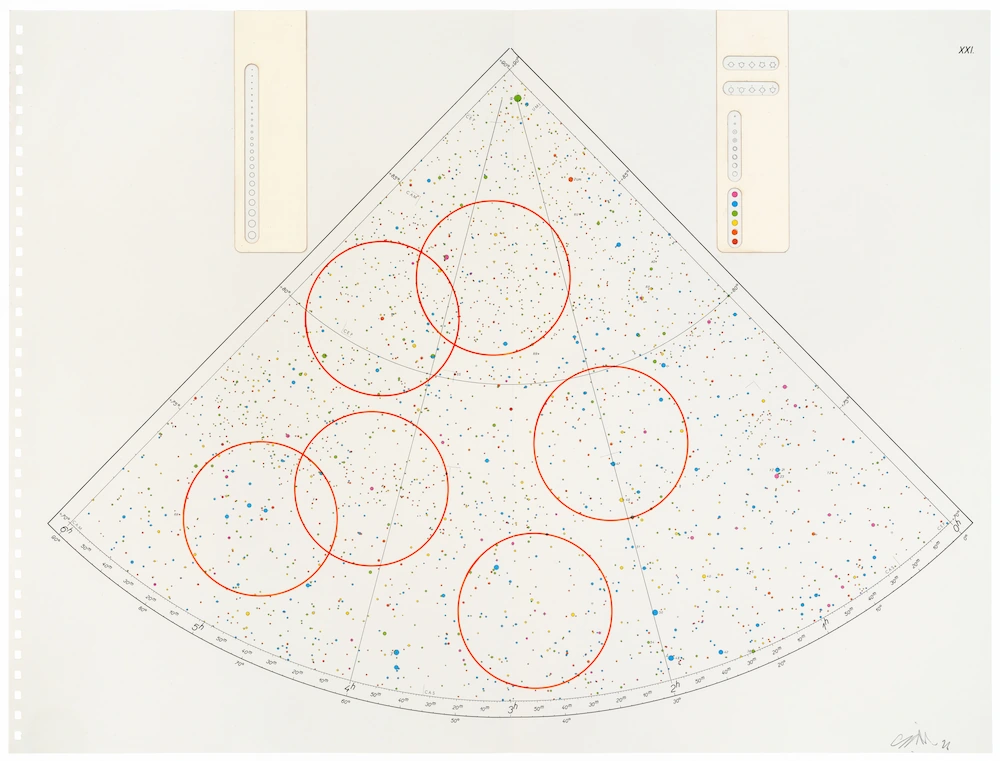
Il che ci porta ai disegni di Atlas Borealis. Ho introdotto su di essi sei cerchi—sei, come i numeri che si scelgono quando si gioca al Lotto—ognuno dei quali racchiude una costellazione casuale. Queste costellazioni stellari sono così gigantesche che il modo in cui si assembrano, in termini di dimensioni e ordine, non può essere che casuale—perché noi le guardiamo dal nostro microscopico punto di vista sulla Terra; e dalla Terra guardiamo questa gigantesca massa di niente se non per pochi Soli, questa immensa quantità di spazio che per noi è difficile da elaborare in termini di comprensione—ma credo di stare andando fuori tema rispetto alla tua domanda.
PS: Sei mai stato in una camera anecoica?
CN: Sì, sono stato in parecchie e sono stato anche nella Stanza più Silenziosa del Mondo. È anch’essa una camera anecoica, presso gli Orfield Laboratories di Minneapolis. È stata una bellissima esperienza perché ciò che capisci lì è che non esiste un “non-suono”. Quando entri in uno spazio del genere, quello che succede è che inizi a sentire te stesso. Puoi sentire le tue ciglia, puoi sentire il tuo flusso sanguigno, puoi sentire chiaramente il tuo cuore. Noi non siamo silenziosi. Lì vieni coinvolto molto profondamente nelle attività del tuo corpo.
PS: Abbiamo letto che alle frequenze basse corrispondono forme magmatiche e, almeno in apparenza, caotiche, mentre quelle alte producono schemi ritmici molto precisi. Ci sembra che gli esiti morfogenetici delle tue architetture sonore rimandino a una predilezione per le frequenze alte, e alla vocazione analitica del modernismo.
Se dovessimo attribuire, semplificando, delle frequenze al nostro tempo, diresti che il nostro è un tempo qualitativamente a alta o a bassa frequenza?
CN: Non penso che le frequenze ritmicamente architettoniche siano necessariamente quelle alte. Penso che possano essere sia basse che alte—non faccio una divisione, le vedo insieme. Dobbiamo capire che le nostre frequenze “basse” e “alte” sono tali per noi, e si applicano solo a noi come esseri umani. Per diversi animali, insetti, o altro, la definizione di frequenza alta e bassa è diversa. Forse alcune delle frequenze che noi sentiamo o vediamo sono fuori dalla loro portata, nello stesso modo in cui le frequenze che possiamo sentire noi arrivano solo fino a un certo punto. Prendi le alte frequenze. Il limite di ciò che possiamo sentire o percepire è intorno ai 20.000 hertz. Quello che sto cercando di dire è che le nostre “alte” frequenze sono decisamente basse rispetto all’intera gamma di frequenze, e questo concetto di “alto” e “basso” si applica solo agli esseri umani. In realtà vedo il suono come una gamma molto più ampia rispetto alla nostra portata percettiva. Spero che questo possa rispondere un po’ meglio alla tua domanda.
PS: Come attribuisci i colori ai tuoi paesaggi sonori?
Che frequenza ha il bianco?
CN: Questa è una domanda molto semplice. Per definizione, la luce bianca contiene al suo interno l’intero spettro delle frequenze—quindi, più o meno, tutti i colori. Anche la definizione di rumore bianco è stata creata in relazione a questo—perché anche con il rumore bianco hai fondamentalmente tutte le frequenze all’interno. E in questo senso è anche una bellissima metafora—il fatto che una luce bianca, che noi tendiamo a considerare la forma più pura e semplice, sia in realtà un massimo da cui puoi filtrare qualsiasi colore, perché quel colore è già al suo interno. E lo stesso vale per il rumore bianco: ogni tipo di pezzo musicale, ogni tipo di rumore o suono è già al suo interno. Il bianco è come un enorme pezzo di marmo: puoi crearci qualsiasi tipo di scultura—e lo stesso vale per la materia che ci circonda. Quindi, anche se il bianco ci sembra sempre così puro e vuoto, è in realtà l’esatto opposto. Il bianco è il massimo assoluto.
PS: Che cosa presenterai da Pinksummer?
CN: Da Pinksummer presenterò i 24 disegni Atlas Borealis.
Colleziono atlanti stellari da molti anni e ne sono affascinato. Allo stesso tempo, volevo creare qualcosa appositamente per Pinksummer e Genova in connessione con il gioco del lotto, in cui si “gioca a dadi” con i numeri e la casualità. Ciò mi ha fornito una base sistemica per l’idea che non possiamo prevedere la casualità o i numeri; Genova è stata la culla del lotto moderno, quindi c’è ovviamente un forte legame tra la città e il concetto di caso.
Ho preso questi disegni come fonte per costellazioni casuali che sono così gigantesche—come ho detto prima—da poter essere descritte solo come casuali. Attraverso i sei cerchi che ho disegnato su di essi, ho più o meno definito una costellazione casuale di punti su ogni mappa—diverse dimensioni, diverse distanze, diversi pesi—rendendola una possibile fonte per altri lavori. Queste composizioni potrebbero essere in seguito una fonte di dati casuali per la scrittura di un nuovo programma di composizione, o di nuovi modelli visivi. In un certo senso per me questa è una fonte fondamentale per il futuro.
Ma i disegni stessi sono belli anche in sé, perché hanno una loro logica. Ho tracciato i cerchi senza cercare di seguire alcun tipo di regola su come e dove posizionarli—e questo è probabilmente ciò che noi chiamiamo “intuizione”, o meglio, “scelte intuitive”. È in questo che credo davvero.
Spero di aver risposto a tutto e vi ringrazio molto.
***
Press release in interview format
Pinksummer: Recently you said that you are trying to merge two personalities into one, to bring everything together into a single whole.
It made us think of the quantum paradox of Schrödinger’s cat, existing in a superposition of being both alive and dead at the same time.
In fact, we have always thought of the identities of Carsten Nicolai and Alva Noto as a superposition of possible states. After all, it seems that the first particle of matter emerged spontaneously from the void thanks to a vibrating energy: in some civilizations it is called the Word, in others “the songlines”, and if we were to extend our search through time as well as space, we would reach as far as the Tower of Babel.
It is said that what we perceive as solid is an illusion, and that the universe should instead be understood as a conglomerate of essential energy vibrating at different speeds—or rather, at different frequencies.
Does the solid and highly essential illusion of Carsten Nicolai not arise from the environments which we like to define as the “cymatic landscapes” of Alva Noto?
Carsten Nicolai: I’m not necessarily trying to merge my two personalities into one. Maybe it’s more about the perception of the outside world, because as we know, there’s still quite a big division between the world of music and the world of visual arts. And sometimes these worlds do collide—or at least in my terms they do a lot, of course, and they interact—but in the perception of the press, and the research, and the history of art as well, it is still a pretty much debated and probably unripe idea that these two worlds may naturally belong together. So I’m especially working on communicating that they do, and don’t necessarily need a division.
As for the parallel that you brought up with the paradox of Schrödinger’s cat… I think that’s a little bit too strong for me, because I hope neither of my personalities is dead. Just making a little note on this.
You’re also talking about solids, illusion, and the universe as a conglomerate of essential energy vibrating at different speeds, or frequencies. I think this is quite a beautiful metaphor. When talking about such deep topics, and the fact that we don’t completely understand what we are surrounded with, I think that if to this day we still don’t really know what this universe around us consists of, probably most of the stuff it consists of is not material, is not materia [“matter”, in Italian in the text]. So solids—what we are producing here—are actually pretty rare. And, of course, this way this ends up being more of a philosophical matter.
But I do like this metaphor about electromagnetic frequencies, because I think we can describe pretty much everything through electromagnetic frequencies, and energy levels. In this case, I would probably go as far as to say I actually prefer Rudolf Steiner’s idea, that Joseph Beuys also exploited—the idea of energetics, of the immaterial. And maybe we could work with this metaphor, while knowing that it stands for something that we cannot completely understand in a scientific way. Or maybe, we could have a different approach. Maybe we can see things from a religious point of view, or from a metaphoric, or poetic point of view. But I think approaching such topics on an artistic level is a very open and fruitful way of looking into this kind of fundamental questions.
PS: We have read that Hans Jenny, in his cymatic experiments applied to words from ancient languages such as Sanskrit and Hebrew, found that the figures produced by the frequencies corresponded to the alphabetic symbols of those same languages. This brought to mind Cratylus, the dialogue by Plato in which Cratylus and Hermogenes discuss whether language is conventional or whether names reflect the nature of things. It seems that those ancient civilizations were already aware of the relationship between sound and visible form.
In this sense, technology reconnects us to the minimal and unadorned origins of language. In the case of your art, which symbolically rejects ornament and redundancy, do you truly believe that sound is a universal language not mediated by convention?
CN: In many ways, cymatics is a reference for my work.
But I’m actually no turning to cymatics in its classical sense, because Hans Jenny is a bit more parascientific in his way of explaining it, while I’m actually leaning much more towards a scientific approach here. My work refers more to Hermann von Helmholtz’s theories of frequencies and transmission, and doesn’t just look into sound, but into a wider range of electromagnetic frequencies from radio to light—including parts that are imperceptible to us. That’s maybe the main reason. And there’s a few moments where this kind of constellations manifests in a visual way. There are photographs, for example, of an installation I made using water, or milk, researching the way frequencies produce interference patterns on liquids.
I’m not a huge fan of the theory that language and words correspond directly to specific parts of cymatics. There are many reasons why I’m a little bit skeptical about that, but I don’t find that idea so convincing. Yeah. I’m taking a different path than Hans Jenny here, let’s put it like that.
“Do you truly believe that sound is a universal language, not mediated by convention?” Yes, I think that sound is a universal language because first of all, it’s accessible to everyone, since we all have the ability to hear. Perhaps we need to free ourselves from the understanding of language. And when I say language, I don’t mean spoken language—what I’m just now recording, for instance. I’m referring here to the effect of constellations of notes, or frequencies, to the way they can talk to us. I think this is an innate ability, culturally speaking.
There are, of course, different hearing patterns, connected to cultural context. A good explanation might be that in terms of harmonics, different scales or tonalities may be perceived differently. In that sense, it might be more of a social definition, if that’s what you’re referring to. But in general, I believe that sound is a universal language that can connect us very easily to each other—and maybe to the outside as well. A great example is when we tried to be seen by possible alien life forms; we basically expressed ourselves, our identity, and our existence, through a Golden Record that just contains sound, music, and some pictograms—the most fundamental communication forms. And we could say that if a pictographic alphabet is the fundamental visual form, then sound is the most basic form of communication in terms of hearing.
PS: Do you think the music of the Pythagorean spheres—what Boethius, a few centuries later, defined “musica mundana”—is comparable to cosmic microwave background radiation, the “fossil” echo of the Big Bang, discovered, incidentally, in 1965, the year of your birth?
CN: There has been a lot written about it, and a number of debates. I guess I’m a bit skeptical—or it might just be that the idea of there being a harmonious constellation of Nature, where everything goes in cycles, by perfect units… I think we all know by now that’s probably not the case. Things are much more complex than that. What instead may apply to all of our findings is the idea that Nature follows a sort of masterplan designed by God or, in this case, by some kind of force, if that makes sense.
I want to bring up a remark Einstein made about quantum mechanics, a beautiful phrase that probably relates strongly to the work I’m showing in Genoa. He said that “God does not play dice”—meaning He doesn’t make things arbitrarily or without reason. This is the common ground that drives scientists to believe in research, and is maybe also one of the reasons why I’m so interested in these kinds of constellations: what is randomness, actually? Does it “care” or does it not follow any kind of rule or order?
Which brings us to the Atlas Borealis drawings. I have introduced six circles on them—six, like the numbers you choose when you play the Lotto [“lottery”, in Italian in the text]—each enclosing a random constellation. These star constellations are so gigantic that how they sit together in terms of size and order can only be random—because we look at them from our microscopic point of view on Earth; and from Earth we look at this gigantic mass of nothing but a few Suns, this immense amount of space that is hard to process for us in terms of understanding—but I think I’m drifting away from your question here.
PS: Have you ever been in an anechoic chamber?
CN: Yes, I have been in quite a few and I have also been in the Quietest Room on Earth. That is also an anechoic chamber, at Orfield Laboratories, in Minneapolis. It was a great experience because what you understand there is that there is no “no-sound”. When you come into such a space what happens is, you start hearing yourself. You can hear your eyelashes, you can hear your bloodstream, you can hear your heart clearly. We are not silent. You get very deeply involved in your body’s activities there.
PS: We have read that low frequencies correspond to magmatic and, at least in appearance, chaotic forms, while high frequencies produce very precise rhythmic patterns. It seems to us that the morphogenetic outcomes of your sound architectures suggest a preference for high frequencies and the analytical vocation of Modernism.
If we were to simplify and assign frequencies to our time, would you say that ours is qualitatively a high-frequency or a low-frequency time?
CN: I don’t necessarily think that rhythmically architectural frequencies are high. I think they can be both low and high—I don’t make a division, I see them together. We have to understand that our “low” and “high” frequencies are such for us, and only apply to us, as humans. For different animals, insects, or whatever, the frequencies of low and high have a different definition. Maybe some of the frequencies we hear or see are out of their range, just like the frequencies we can hear only go up to a certain point. Take high frequencies. The limit of what we can hear or perceive is around 20,000 hertz. What I’m trying to say is that our “high” frequencies are definitely low compared to the full range of frequencies, and this concept of “high” and “low” only applies to humans. I actually see sound in a much wider range than our perceptive range. I hope this can answer your question a little bit better.
PS: How do you assign colors to your soundscapes?
What frequency does white have?
CN: This is a very simple question. By definition, white light contains the whole spectrum of frequencies in it—so more of less, all colors. The definition of white noise has been also created in relation to this—because with white noise, too, you basically have all the frequencies inside. And if you look at it, it is also a very beautiful metaphor—how a white light, which we tend to consider the purest and simplest form, is actually a maximum you can filter any color out of, because that color is already inside of it. And the same goes for white noise: any kind of music piece, any kind of noise, or sound, is already inside of it. White is like a huge piece of marble: you can create any kind of sculpture with it—and the same goes for the matter surrounding us. So, even though white always feels so pure and empty to us, it is actually the complete opposite. White is the absolute maximum.
PS: What will you be presenting at Pinksummer?
CN: I’m presenting 24 drawings of the Atlas Borealis at Pinksummer.
I have been collecting star atlases for many years, and I have a fascination with them. At the same time, I wanted to create something specifically for Pinksummer and Genoa in connection to lottery, where you “play the dice” with numbers, and randomness. This gave me a systemic base for the idea that we can’t predict randomness, or numbers; Genoa was the birthplace of modern lottery, so there is obviously a strong connection between the city and the concept of chance.
I took these drawings as a source for random constellations that are so gigantic—as I said earlier—they can only be described as random. Through the six circles I’ve drawn on them, I have more or less defined a random constellation of dots on each map—different sizes, different distances, different weights—making it a possible source for other works. These compositions could be later on a source of random data for writing a composition program, or new visual patterns. This is kind of a very fundamental source for me in the future.
But the drawing themselves are also beautiful, because they have their own logic. I made the circles without trying to follow any kind of rule as for how and where to place them—and that’s probably what we call “intuition”, or rather, “intuitive choices”. That is what I really believe in.
I hope this answers everything and thank you very much.
