
Michael Beutler – Onion
Mostra personale.
Comunicato stampa
Pinksummer: Un paradosso della filosofia è che intenda che il lavoro non esistesse prima di Hegel se non come informe macula servile, a parte qualche eccezione — come la Sancta Regula dettata da San Benedetto con il suo ora et labora, prega e lavora. Hegel, di fatto, nel IV capitolo della Fenomenologia dello spirito focalizza sulla dialettica servo-padrone affermando che il lavoro ribalta i punti di forza, giacché il padrone, non lavorando, dipende dal servo, e finisce per perdere il contatto con la realtà oggettiva.
Mentre il servo, lavorando, imprime la propria forma e razionalità sulla materia, questo atto gli conferisce auto-coscienza e una libertà superiore. Hegel vede il lavoro come atto di auto-generazione dell’uomo, l’uomo è il risultato del proprio lavoro. Soddisfacendo i bisogni della società civile, il lavoro inserisce il singolo in una rete di dipendenza reciproca e di cooperazione. Lavorando si diventa soggetti storici. Hegel ha intravvisto appena il pericolo della meccanizzazione dell’uomo rispetto al lavoro astratto e parcellizzato dalla rivoluzione industriale. La critica di Marx rende l’idea di lavoro più materiale e sensibile, e soprattutto intende lo Stato come lo strumento delle classi dominanti e il capitalismo come la distorsione economica del mercato sganciato dalla necessità e dall’utilità collettiva.
Hai sempre detto che rispetto alla tua opera il processo è importante quanto il risultato, e che il lavoro, soprattutto il lavoro comunitario, appare fondamentale per ogni realizzazione. Crediamo che tu abbia una concezione del lavoro materiale oltremodo spirituale circa l’auto-generazione, la formazione umana e l’auto-coscienza.
Nel 2026 I lavoratori non sono solo separati dal prodotto finito come dopo la rivoluzione industriale, ma in questa fase di capitalismo finanziarizzato il lavoratore viene proprio scollato dalla sua intelligenza, talvolta utilizzata per addestrare algoritmi che potrebbero sostituirlo. L’algorithmic management dell’AI decide assunzioni, licenziamenti e carichi di lavoro basandosi sui big data. Il potere aziendale diventa poco penetrabile, opaco e difficilmente contestabile.
Cosa direbbero oggi Hegel e Marx sulla precarizzazione dal lavoro, sulla compressione dei salari, sulla de-professionalizzazione, sulla sussunzione reale del lavoro al capitalismo digitale? Il lavoro uscirà definitivamente dall’umanità per entrare nello spurio calcolo algoritmico?
Michael Beutler: Immagino che il lavoro ci sarà sempre, in parte piuttosto distaccato e in parte com’è sempre stato. Ci sono lavori che l’IA non può sostituire, come quello dell’idraulico. E anche se c’è una grande ricerca su come i processi edilizi possano essere resi più individualizzati grazie all’IA e agli strumenti robotici… c’è anche il lento passaggio alla comprensione dei limiti della tecnologia. Tutto diventa semplicemente più complesso e meno piacevole. C’è un forte desiderio di routine più semplici, di modi di lavorare insieme più semplici e più comunicativi. Credo che gli esseri umani manterranno il lavoro alla loro portata. Ma è vero che la situazione attuale è preoccupante e non tutti hanno il potere di decidere per sé. Non voglio immaginare quante persone perderanno il lavoro a causa dell’IA. Che cosa faranno invece?
PS: Il tuo fare rimanda all’attivismo DIY, all’approccio anticonsumista e all’empowerment che promuove l’autosufficienza, creando alternative altamente creative e solidali che preparano un sostrato ontologico sia nei team che formi che nei visitatori. Tutti diventano partecipanti, come nel Progetto dello scorso anno Bozar Monumental Flow Motion, nella Horta Hall. Le macchine manuali che inventi on the job per la realizzazione delle tue installazioni sono parti ineludibili della mostra, come a sottolineare il fertile rapporto tra lavoro e conoscenza tipica degli artigiani, in un mondo dominato dall’automazione AI.
In passato il progresso e il fiorire di invenzioni era opera di lavoratori manuali in un clima collettivo, preparato in termini filosofici dalla rivoluzione scientifica: Thomas Newcomen, inventore della macchina a vapore nel 1705, era un fabbro; John Kay, che nel 1733 inventò la spoletta volante, un filatoio meccanico, era un commerciante di stoffe; Abraham Darby, pioniere dell’industria siderurgica del Settecento, era un fonditore ex mugnaio. Lavoratori con tanta voglia di sperimentare e energia da vendere. L’ascesa sociale passava per l’ufficio brevetti.
Il capitalismo finanziarizzato che vola su ali tecnologiche, come del resto quello manifatturiero prima di esso, si basa sul consenso sociale, e in questo senso i social e le fabbriche di fake news sovranazionali sono decisamente pane per i suoi denti.
Abbiamo sempre inteso la tua estetica tecnicizzata come uno spazio di disobbedienza e anche una strategia di sopravvivenza.
Ancor oggi nessuno dovrebbe parlare seriamente parlare di lavoro senza mai aver annusato l’odore del metallo tornito e fresato?
MB: Beh, no. Chiunque dovrebbe avere il diritto di parlare. Credo sia positivo per tutti capire che ciascuno ha una comprensione diversa di ciò che fa. Un manager che non abbia mai toccato il legno potrebbe comunque avere delle buone idee su come gestire una sedia realizzata da un falegname. Penso che siamo molto fortunati a vivere in questo mondo insieme, e non da soli. Non sento nessun bisogno di rivendicare tutta la conoscenza che ho del mio lavoro. Lavoro come lavoro per essere indipendente, ma questo non significa che non mi interessi l’opinione di qualcuno che magari non ha la minima idea di ciò che faccio.
PS: Una volta hai detto che per un contadino la macchina più bella è quella che è a tal punto parte del sistema della sua agricoltura che si dissolve completamente in esso, scardinanado completamente, aggiungiamo noi, l’idea di consumo passivo. Credi che si potrebbe tornare un poco indietro e immaginare con metodo l’idea di espressione libera senza apparire idioti? Potrebbe essere questo il senso del turning gate nella mostra Onion che presenterai da Pinksummer e quello del Flow Motion del Bozar? Senza tropi nostalgici, li si potrebbe un po’ intendere come Puertas del retorno per riancorarci un pochino a quella che Hegel considerava la realtà oggettiva? Il senso dello zootropio all’interno di Flow Motion ci è apparso come una sorta di addestramento rispetto alle illusioni.
MB: Non so cosa farà Onion alle persone, né se girerà e galleggerà oppure affonderà del tutto… non è ancora finito. Ma Flow Motion era quasi bizzarro. È così a bassa tecnologia. Tutto quello che c’era avrebbe potuto essere realizzato già cent’anni fa… Mi piace molto la semplicità e il modo in cui il nostro stesso sistema visivo ci inganna. Quella relazione tra noi stessi e la struttura è una cosa speciale di questo lavoro, ma la parte davvero bella è vivere la magia insieme: osservare come anche tutti gli altri si interrogano intensamente sulla realtà non appena entrano nel cancello rotante.
PS: Abbiamo sempre l’impressione, di fronte al tuo lavoro, che tu riesca a tirare fuori veri e propri conigli reali da cappelli metafisici. Forse è solo stupida immaginazione, ma tutta questa metafora delle cose rotanti, e in particolare l’idea del turning gate, ci ha rimandato al film del regista coreano Hong Sang-soo del 2002 On the occasion of remembering a turning gate, un film che parla d’amore senza essere un film sentimentale, un’opera in cui si cerca il contatto, ma si trova il vuoto. Nel film si sente due volte pronunciare la battuta: “E’ difficile essere umani, cerchiamo di non diventare mostri”. Il regista muove dalla favola/leggenda coreana del popolano che s’innamora della principessa e si reincarna in un serpente il quale, seguendola, rimane fuori dalla porta del tempio — il turning gate, un cancello del tempo — in un’attesa indeterminata e inutile fino a quando una tempesta di tuoni e di fulmini lo spaventa, facendolo scappare indietro. Il turning gate appare una metafora del destino, e a proposito di serpenti e della Corea ci è venuta anche in mente la figura dell’imugi, un serpente antico, una sorta di divinità, un oracolo che presiede al confine tra il sacro e il profano. L’imugi sogna di diventare drago; è una creatura in divenire che aspira a una evoluzione spirituale e rappresenta un potenziale non ancora realizzato. Se la sua attitudine di desiderio e perseveranza tende a finalizzarsi, diventa un protettore delle acque e della natura; se la sua volontà è frustrata, diventa uno spirito vendicativo.
In questo particolare momento della Storia, l’umanità appare assai frustrata e vendicativa: un cancello che gira potrebbe assomigliare a un simbolo di vita e di cambiamento necessario.
A proposito di memoria, sono trascorsi oltre cinque anni e tre mesi dalla tua ultima mostra da Pinksummer, Keep Beating below 65°. Era l’ottobre del 2020, il Covid era iniziato a febbraio, eravamo rimasti chiusi nelle nostre case per tutta la primavera, l’estate ci aveva fatto ritrovare il respiro e nell’intervista comunicato stampa di quella mostra affermasti: “Il Covid 19 è ancora in circolazione, e verrà affrontato solo quando lavoreremo tutti assieme. Internet ha aiutato a diffondere l’informazione e a tenere le persone impegnate nelle loro case solitarie, ma continua anche a spargere informazioni errate e molte verschwörungstheorien (teorie cospirazioniste). Internet mi ha dato modo di parlare con i miei studenti, ma incontrarci dopo qualche mese ci ha reso molto felici. Quindi, suppongo, Keep beating below 65° — perché non vogliamo che questa bella schiuma collassi. Sbattere energicamente ma con attenzione, direi. Vorrei tantissimo organizzare un piccolo workshop nella galleria, con solo tre o quattro persone a creare delle belle forme schiumose, che lentamente cresceranno, insieme, fino a formare una sorta di grande struttura che conquisterà lo spazio e ci separerà di nuovo gli uni dagli altri, ma mostrerà anche — spero — la gioia della sua creazione collettiva”.
Proprio durante la realizzazione della mostra, molti ragazzi del team che improvvisammo si ammalarono di Covid — senza brutte conseguenze grazie al cielo, si trattava di giovani. Si presentò un lungo inverno, non terribile in Italia come durante il primo lockdown, ma cupo ugualmente.
Le tue parole e quella bella mostra che escludeva la solitudine ci avevano rincuorato, ma le forme schiumose della società civile appaiono da allora un po’ collassate, come se l’umanità fosse rinchiusa ancora in un arcano meccanismo di difesa che si attiva per respingere emozioni spiacevoli provocate da esperienze negative. Come se l’ansia e la paura ci avessero buttato in un circolo vizioso. Il turning gate potrebbe rappresentare un meccanismo psicologico di avvitamento in questo senso, in considerazione delle prospettive in atto nel presente, ammesso che il tempo si mantenga lineare però come un serpente arrotolato?
MB: I cancelli rotanti e le altre opere sull’acqua creano tutte situazioni intense e in cui di solito le persone fanno gruppo. Non è tanto il laboratorio dell’ultima mostra a creare un legame sociale, quanto questa strana esperienza visiva condivisa con gli altri visitatori che potresti trovare all’interno della giostra (i cancelli rotanti sono, naturalmente, anche giostre, solo che qui non sei mosso… vieni trasportato mentalmente).
Quando entri in un cancello, tutto intorno a te si muove. Nessun suono accompagna il movimento o dà prova acustica della sensazione visiva. Il tuo corpo percepisce il movimento, ma i piedi non camminano. Per un momento potresti sentirti completamente distaccato dallo spazio familiare che la galleria ti aveva promesso entrando, e per un attimo, potresti distaccarti anche da tutti i problemi là fuori. Una magia puramente fisica ti risucchia all’interno.
Per un buon numero di persone, il Flow Motion del Bozar era troppo intenso. Dovevano lasciare rapidamente il cerchio interno, e allora potevano trovare sollievo osservando da fuori il rotore in continuo movimento.
Sono gli stessi spettatori a ruotare il cancello. Il movimento c’è solo dove c’è interazione. Con la punta del dito, hai il potere di far girare la struttura, per te e per tutti gli altri.
L’Onion dipende anche dalle persone. Ti invita a giocare. Il gioco ha potenziali ed effetti positivi, ed è profondamente connesso alle creature di questo pianeta, non solo umane. Moltissime persone, sedendosi dentro al Flow Motion, si sono limitate a sorridere con trasporto.
PS: La tua nuova personale da Pinksummer si chiama Onion, “cipolla”, e anche su questo abbiamo ragionato nel nostro modo strambo. Per gli antichi egizi la cipolla, con i suoi strati concentrici, le sue “tuniche”, rappresentava la vita eterna; nell’esegesi biblica era un simbolo di corruzione della mente e di dolore pungente; in altre epoche, simbolo di doppiezza per le false lacrime che provoca. La cipolla è stata anche uno strumento di pratiche divinatorie: le ragazze indecise sui pretendenti incidevano le iniziali di ciascuno sulle cipolle, e la prima che germogliava indicava l’uomo da scegliere.
Ovviamente ci è venuta in mente The Onion, la performance di Marina Abramović del 1995. Per semplificare, diremmo che la performance focalizzava sul potere positivo e liberatorio del pianto.
La poetessa polacca Wisłava Szymborska, in una poesia, parla della “cipollosità” della cipolla, che, “cipolluta” fino al cuore, “potrebbe guardarsi dentro senza provare timore”.
Perché hai chiamato Onion la terza personale di Michael Beutler da Pinksummer?
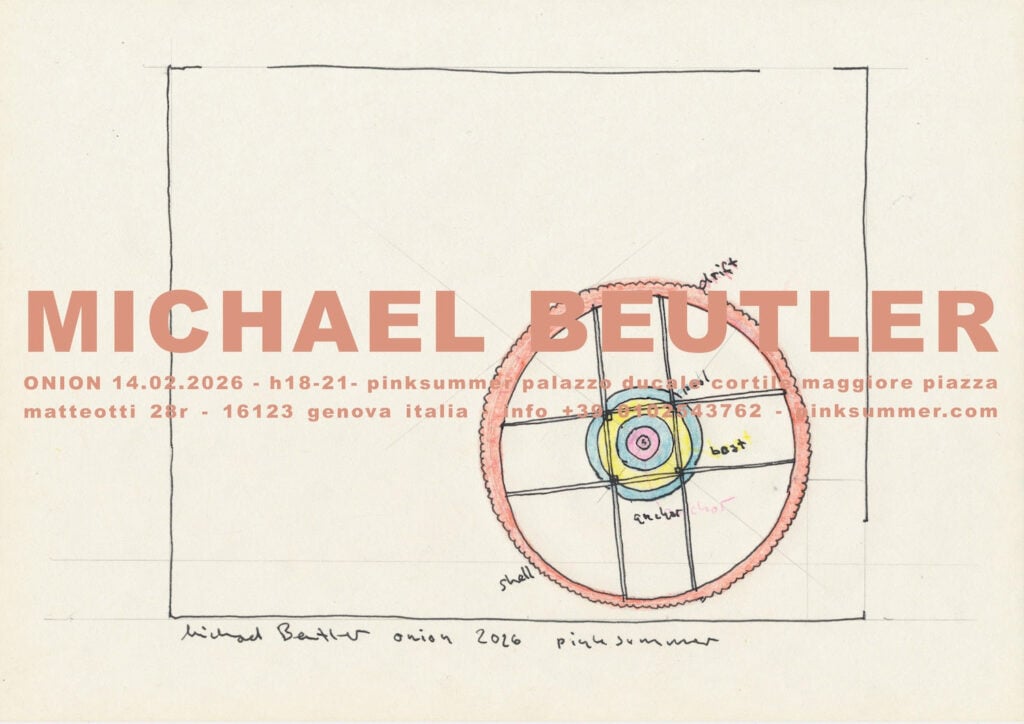
MB: Per via di un libro per bambini italiano, Le avventure di Cipollino. Ho provato a leggerlo a mia figlia, ma credo di dover aspettare ancora un po’. Potrebbe essere più una coincidenza che altro. Un altro motivo è l’uso architettonico della cipolla come simbolo di molteplici strati termici nelle pareti, per creare aree definite con temperature specifiche. In sé, Onion è una stanza all’interno della galleria, che a sua volta è una stanza all’interno del palazzo. E dentro Onion ci sono altri strati: una piscina, una barca a forma di anello con un altro anello al centro e un palo, come ancoraggio interno a questo centro. Il palo impedisce alla barca di urtare i bordi della piscina, e allo stesso tempo permette i movimenti di galleggiamento della struttura. Il centro della fontana non coincide quindi necessariamente con il centro del movimento. La rotazione non segue tanto la linea di un cerchio, quanto piuttosto… di una cipolla.
***
Pinksummer: A paradox of philosophy is that it understands work as non-existent before Hegel if not as a formless mark of servitude, with few exceptions — such as the Sancta Regula set forth by Saint Benedict with its ora et labora, pray and work. As a matter of fact Hegel, in chapter IV of his Phenomenology of Spirit, focuses on the master-slave dialectic maintaining that work overturns its strengths, as the master, not working, depends on the workingman, and ends up losing touch with objective reality.
As the workingman, while working, impresses his form and rationality on matter, this act endows him with self-consciousness and a superior freedom. Hegel sees work as an act of human self-generation, a man is the result of his work. By satisfying the needs of civil society, work integrates the individual into a network of mutual dependence and cooperation. Through labor, one becomes a historical subject. Hegel only briefly glimpsed the danger of the mechanization of the human under the abstract and fragmented work brought about by the Industrial Revolution. Marx’s critique renders the concept of labor more material and sensuous, and above all understands the State as an instrument of the dominant classes, and capitalism as the economic distortion of a market detached from necessity and collective utility.
You have always maintained that, in relation to your work, the process is as important as the result, and that work—especially communal work—appears fundamental to any realization. We believe that you hold a conception of material labor that is profoundly spiritual with regard to self-generation, human formation and self-consciousness.
In 2026, workers are not only separated from the finished product, as they were after the Industrial Revolution; in this phase of financialized capitalism, the worker is in fact unglued from their own intelligence, which is sometimes employed to train algorithms that could replace them. AI-driven algorithmic management decides hiring, firing and workloads based on big data. Corporation power becomes difficult to penetrate, opaque and hard to contest.
What would Hegel and Marx say today about the precarization of work, the wage compression, the de-professionalization, the real subsumption of work under digital capitalism? Will work ultimately exit humanity and fall into spurious algorithmic calculation?
Michael Beutler: I guess there will always be work, some of it quite detached and some as it always has been. There are works that AI cannot substitute, like the work of the plumber. And even though there is big research in how building processes could be individualized with AI and robotic tools… there is also the slow shift in understanding the limits of technology. Everything just becomes more complex and less enjoyable. There is a big longing for simpler routines, simpler and more communicative ways of working together. I believe that humans will keep work within their reach. But it is true the situation today is worrying and not everybody has the power to decide for themselves. I don´t want to imagine how many people will lose their jobs due to AI. What will they be doing instead?
PS: Your practice evokes DIY activism, the anti-consumerist approach, and the empowerment that promotes self-sufficiency, creating highly creative and collaborative alternatives that prepare an ontological substratum both among the teams you form and among visitors. Everyone becomes a participant, as in last year’s Bozar Monumental Flow Motion project in the Horta Hall. The manual machines you invent “on the job” for the
making of your installations are indispensable parts of the exhibition, as though highlighting the fertile relationship between work and knowledge typical of artisans, in a world dominated by AI automation.
In the past, progress and the flourishing of inventions were the work of manual workers operating in a collective environment, philosophically prepared by the Scientific Revolution: Thomas Newcomen, inventor of the steam engine in 1705, was a blacksmith; John Kay, who in 1733 invented the flying shuttle, a mechanical loom, was a cloth merchant; Abraham Darby, pioneer of the eighteenth-century iron industry, was a former miller turned founder. Workers with a strong will to experiment, and boundless energy. Social advancement often passed through the patent office.
Financialized capitalism, which soars on technological wings — as after all did the manufacturing one before it — relies on social consent. In this sense, social media and transnational fake-news factories are very much to its advantage.
We have always understood your technicalized aesthetic as a space of disobedience, and also as a survival strategy. Is it the case that even today, no one should speak seriously about labor without having once smelled the scent of turned and milled metal?
MB: Well, no. Anybody should have the right to talk. I think it is good for everybody to understand that we all have different understandings of what we do. A manager, who never has touched wood, might have some good ideas about how to deal with a chair a carpenter has made. I think we are very lucky to in this world together and not alone. I feel no need to claim all the knowledge I have about the work I do. I make my work the way I do to be independent, but this doesn´t mean that I wouldn`t be interested in the opinion of someone who might not have a clue about what I do.
PS: You once said that, for a farmer, the most beautiful machine is the one that becomes so integrated into their agricultural system that it completely dissolves within it — completely dismantling, we might add, the notion of passive consumption. Do you believe it might be possible to take a step back and methodically imagine the idea of free expression without appearing foolish? Could this be the sense of the turning gate in the Onion exhibition you will present at Pinksummer, and of the Flow Motion at Bozar? Without nostalgic tropes, could they be loosely understood as Puertas del retorno, helping us reconnect somehow to what Hegel considered objective reality? The sense of the zoetrope within Flow Motion appeared to us as a form of training against illusions.
MB: I don´t know what Onion will do to people, or if it will turn and float or sink altogether… it is not finished yet. But Flow Motion was almost bizarre. It is so low tech. All that was there could have been made some hundred years ago… . I really enjoy the simplicity and the way our own looking system tricks ourselves. That relation between ourselves and the structure is one special thing about this work, the really nice thing though is to experience the magic together: to observe how everyone else is also heavily wondering about reality as soon as they have entered the turning gate.
PS: We always have the impression, when faced with your work, that you manage to pull real, living rabbits out of metaphysical hats. Perhaps it’s just foolish imagination, but all this metaphor of rotating things, and in particular the idea of the turning gate, brought to mind the 2002 film by the Korean director Hong Sang-soo, On the Occasion of Remembering a Turning Gate: a film that speaks about love without being a sentimental film, a work in which contact is sought but emptiness is found. In the film, this line is spoken twice: “It’s hard to be human; let’s try not to become monsters.” The director draws from the Korean fable/legend about the commoner who falls in love with the princess and is reincarnated as a serpent which, following her, remains outside the temple gate — the turning gate, a gate of time — in an indeterminate and useless wait, until a storm of thunder and lightning frightens it and makes it flee backward. The turning gate appears as a metaphor for destiny, and speaking of serpents and Korea, we were also reminded of the figure of the imugi, an ancient serpent, a kind of divinity, an oracle that presides over the boundary between the sacred and the profane. The imugi dreams of becoming a dragon; it is a creature in the process of becoming, aspiring to a spiritual evolution and representing a potential not yet realized. If its attitude of desire and perseverance comes to fruition, it
becomes a protector of waters and nature; if its will is frustrated, it becomes a vengeful spirit.
In this particular moment in History, humanity appears rather frustrated and vindictive: a rotating gate could resemble a symbol of life and of necessary change.
Speaking of memory, over five years and three months have passed since your last exhibition at Pinksummer, Keep Beating below 65°. It was October 2020; Covid had begun in February, people had remained shut inside their homes all spring, summer had allowed us to catch our breath again and in the press release interview for that exhibition you stated: “Covid 19 is still around and will only be dealt with when all are working together.
The Internet has helped spread information and keep people busy in their lonely homes, but it also keeps spreading wrong information and a lot verschwörungstheorien. The internet provided a way to talk to my students, but meeting them in person after some months really made us very happy. So I guess, Keep beating below 65°, because we don’t want the beautiful foam to collapse. Energetic but careful beating, I would say. I so very much want to set up this tiny workshop in the gallery, that with just three or four people will make some nice foamy shapes, that will slowly grow together to shape some big structure, which will conquer the space, separate us from each other again, but hopefully also display the joy of its togetherly making.”
Precisely during the making of the exhibition, many people from the improvised team became ill with Covid, fortunately without any serious consequences — they were young. A long winter followed — not terrible in Italy like the first lockdown, but gloomy nonetheless.
Your words and that beautiful exhibition which excluded solitude had given us comfort, but since then the foamy forms of civil society appear somewhat collapsed, as if humanity were still trapped in an arcane defense mechanism activated to repel unpleasant emotionscaused by negative experiences. As if anxiety and fear had thrown us into a vicious circle.
In this sense, could the turning gate represent a psychological mechanism of tightening, in consideration of the perspectives at play in the present — assuming that time remains linear, though like a coiled serpent?
MB: The turning gates and other works on water all create intense situations within which people usually come together. It is not so much the workshop of the last exhibition that created a social bond, but it is this strange visual experience you share with other visitors you mind find within the carousel (turning gates are of course also carousels, only you are not being moved… just mentally carried along.)
When you enter a gate, everything around you is moving. No sound is accompanying the movement and gives acoustic proof for the visual sensation. Your body feels the movement, but your feet are not walking. For the moment you might find yourself completely detached from the familiar space that the gallery promised you, as you came in and you might as well for the moment be detached from all the troubles out there. Pure physical magic sucks you in.
It was too much for quite some people in Flow Motion at Bozar. They quickly had to leave the inner circle and could take relief observing the constantly moving drum from the outside.
The observers themselves turn the gate. There only is movement when there is interaction. By the tip of your finger, you have the power to make the thing turn, for yourself and for everybody else.
The Onion depends on people as well. It invites you to play. Play has positive potentials and effects and is deeply connected to not only human creatures on this planet. Very many people simply heavily smiled sitting inside Flow Motion.
PS: Your new solo exhibition at Pinksummer is titled Onion, and on this as well we reflected in our own strange way. For the ancient Egyptians, the onion, with its concentric layers, with its “tunics”, represented eternal life; in biblical exegesis it was a symbol of corruption of the mind and stinging pain; in other times it was a symbol of duplicity, because of the false tears it provokes. The onion was also a tool in divinatory practices: girls undecided among suitors would carve each man’s initials into onions, and the one that sprouted first indicated the man to choose.
Naturally, Marina Abramović’s 1995 performance The Onion also came to mind. To simplify, we would say that the performance focused on the positive and liberating power of crying.
The Polish poet Wisława Szymborska, in a poem, speaks of the “onionhood” of the onion, which, “oniony” all the way to the core, “could look inside itself without feeling fear”.
Why did you Michael Beutler’s third solo show at Pinksummer Onion?
MB: Because of an Italian childrens book Adventures of Cipollino. I tried to read it to my daughter, but I think I have to wait a little longer. This might be more of a coincidence. Another reason is the architectural use of the onion as a symbol for multiple thermic wall layers to create defined areas of specific temperature. Onion itself is a room inside the gallery, which itself is a room inside the palace. And there are more layers within Onion: a pool, a ring-shaped boat with another ring in its center and a pole as an anchor within this center. This pole prevents the boat from hitting the boundaries of the pool and at the some time allows for the buoyant movements of the structure. The center of the fountain is therefore not necessarily the center of the movement. The rotation not so much traces the line of a cirle, but rather maybe… an onion.
